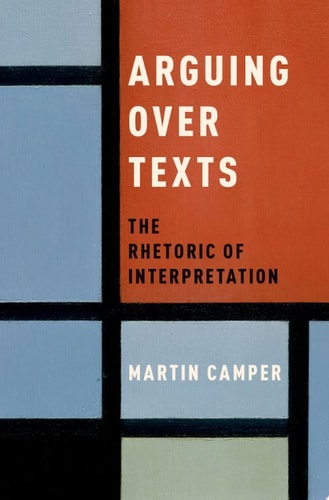
Arguing Over Texts
0
0
As an Amazon Associate and affiliate partner, Menrva Books earns from qualifying purchases. Learn more
Author Description
From The Constitution To The Bible, From Literary Classics To Political Sound Bites, Our Modern Lives Are Filled With Numerous Texts That Govern And Influence Our Behavior And Beliefs. Whether In The Courtrooms Of Our Judiciaries Or Over Our Dining Room Tables, We Argue Over What These Texts Mean As We Apply Them To Our Lives. Various Schools Of Hermeneutics Offer Theories Of How We Generally Understand The World Around Us Or How To Read Certain Types Of Texts To Arrive At The Correct Or Best Interpretation, But Most Neglect The Argumentative And Persuasive Nature Of Every Act Of Interpretation. In Arguing Over Texts, Martin Camper Presents A Rhetorical Method For Understanding The Types Of Disagreement People Have Over The Meaning Of Texts And The Lines Of Argument They Use To Resolve Those Disagreements. Camper's Fresh Approach Has Its Roots In The Long Forgotten Interpretive Stases, Originally Devised By Ancient Greek And Roman Teachers Of Rhetoric For Inventing Courtroom Arguments Concerning The Meaning Of Legal Documents Such As Wills, Laws, And Contracts. The Interpretive Stases Identify General, Recurring Debates Over Textual Meaning And Catalogue The Lines Of Reasoning Arguers May Employ To Support Their Preferred Interpretations. Drawing On Contemporary Research In Language, Persuasion, And Cognition, Camper Expands The Scope Of The Interpretive Stases To Cover Textual Controversies In Virtually Any Context. To Illustrate The Interpretive Stases' Wide Range Of Applicability, Arguing Over Texts Contains Examples Of Interpretive Debates From Law, Politics, Religion, History, And Literary Criticism. Arguing Over Texts Will Appeal To Anyone Who Is Interested In Analyzing And Constructing Interpretive Arguments.
Menrva's Summary
THE THESIS
This book investigates the rhetorical nature of textual interpretation and proposes a method for analyzing how individuals argue over the meaning of texts. Martin Camper, a scholar of rhetoric, draws upon ancient Greco-Roman interpretive stases to provide a framework for understanding why disagreements occur and how they are resolved. By integrating contemporary research in cognition and persuasion, the author argues that every act of interpretation is inherently argumentative and persuasive rather than merely a search for objective meaning.
THE SCOPE MAP
What You Will Find
- A comprehensive application of the ancient interpretive stases to modern contexts.
- A classification system for recurring debates over textual meaning.
- Analysis of interpretive arguments across diverse fields including law, religion, and literature.
Scope Limits
- The text does not provide a guide for determining the 'correct' meaning of a text, focusing instead on the mechanics of the argument itself.
- It does not cover the psychological origins of individual bias beyond the scope of rhetorical strategy.
THE AUTHORITY PERSPECTIVE
Scholars and students of rhetoric frequently identify this work as a significant modern expansion of classical stasis theory. Experts note that the prose is accessible to those interested in argumentation theory while maintaining the academic rigor required for professional study.
Page Count:
216
Publication Date:
2017-01-01
Publisher:
Oxford University Press
ISBN-10:
0190677139
ISBN-13:
9780190677138
Philosophy
Critical thinking
Rhetoric
Communication
Hermeneutics
Linguistics
Community Tags
Similar Books