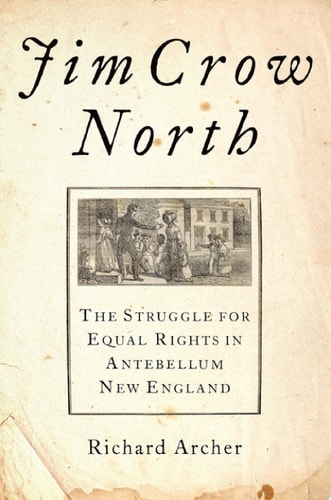
Jim Crow North: The Struggle for Equal Rights in Antebellum New England
0
0
As an Amazon Associate and affiliate partner, Menrva Books earns from qualifying purchases. Learn more
Author Description
More than a century before Rosa Parks refused to give up her seat on a Montgomery bus, Shadrach Howard, David Ruggles, Frederick Douglass, and others had rejected demands that they relinquish their seats on various New England railroads. They were protesting segregation on Jim Crow cars, a term that originated in New England in 1839. Theirs was part of a larger movement for equal rights in antebellum New England. Using sit-ins, boycotts, petition drives, and other initiatives, African-American New Englanders and their white allies attempted to desegregate schools, transportation, neighborhoods, churches, and cultural venues. Above all they sought to be respected and treated as equals in a reputedly democratic society. Jim Crow North is the tale of that struggle and the racism that prompted it.Despite widespread racism, black New Englanders were remarkably successful. By the advent of the Civil War African American men could vote and hold office in every New England state but Connecticut. Schools, except in the largest cities of Connecticut and Rhode Island, were integrated. Railroads, stagecoaches, hotels, and cultural venues (with occasional aberrations) were free from discrimination. People of African descent and of European descent could marry one another and live peaceably, even in Maine and Rhode Island where such marriages were legally prohibited. There was an emerging, if still small, black middle class who benefitted most. But there were limits to progress. A majority of African-Americans in New England were mired in poverty preventing full equality both then and now.
Menrva's Summary
THE THESIS
This work investigates the origins and development of the struggle for racial equality in antebellum New England, challenging the perception that systemic discrimination was exclusively a Southern phenomenon. Richard Archer, a historian, utilizes primary source documentation and historical records to analyze how African Americans and their allies employed early forms of civil disobedience—such as sit-ins and boycotts—to combat segregation in schools, transportation, and public life. The book argues that while these activists achieved significant legislative and social progress before the Civil War, their efforts were constrained by persistent economic inequality and deep-seated societal racism.
THE SCOPE MAP
What You Will Find
- Analysis of early civil rights tactics including petition drives and transportation boycotts.
- Examination of the origins of the term 'Jim Crow' in 1839 New England.
- Assessment of the integration of schools, public venues, and legal rights across New England states.
- Discussion of the emergence of a black middle class during the antebellum period.
Scope Limits
- The text does not provide a comprehensive history of the entire United States, focusing strictly on the New England region.
- It does not offer an exhaustive biography of every activist mentioned, prioritizing the broader movement over individual life stories.
THE AUTHORITY PERSPECTIVE
Historians and scholars frequently cite this work as a critical contribution to understanding the northern roots of American segregation. Readers often note the academic rigor of the research, which effectively dismantles the myth of a racially egalitarian North during the nineteenth century.
Page Count:
312
Publication Date:
2017-10-18
Publisher:
Oxford University Press
ISBN-10:
0190676647
ISBN-13:
9780190676643
History
African Americans
African American
New England
United States
Racism
Civil Rights
American History
Community Tags
Similar Books