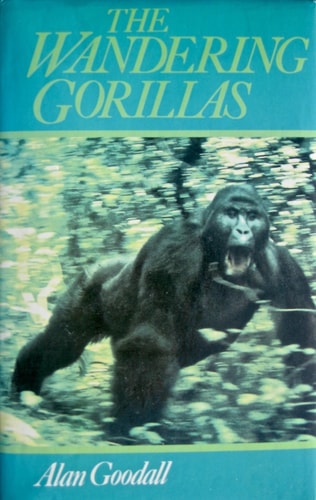
The Wandering Gorillas
0
0
As an Amazon Associate and affiliate partner, Menrva Books earns from qualifying purchases. Learn more
Author Description
In many ways gorillas are the most spectacular of all wild animals. They are enormous, mysterious and secretive, they have many uncanny resemblances to ourselves and their aggressive displays can be both noisy and terrifying.Alan Goodall, a biologist, had the good fortune to conduct the first study to compare two populations of gorillas that have become habituated to man.For eight months he lived in a camp among the Virunga volcanoes of Rwanda, where Dian Fossey had just started her pioneer studies. It was here that he caught his first sight of the mountain gorillas and experienced their nerve-shattering charges. His observations of these superb animals, their social habits and their often-tragic interactions with the people who surround them make absorbing reading.However, perhaps Alan Goodall's most dramatic experiences, and the ones which contribute a new insight to these mountain giants and their relationship with man, were in Zaire (now Congo). During the troubles that followed independence from Belgiun, Adrien Deschryver, fought to preserve the gorillas of Kahuzi-Biega and won acceptance by the government for the reserve he had established. In 1970, the Zaire government gave it the status of a national park. Deschryver had, over several years, partially habituated two families of gorillas to observation and close contact with human beings. This habituation process made possible the author's almost daily study of one of those families - the one led by the silverback (named Casimir by Deschryver) who was later to become world famous in Anglia Television's film ‘Gorilla’This book builds up an enthralling picture of gorillas in their forest how they find their food and what they eat, how they behave with each other, how populations differ in habit and, above all, how they are now dependent upon, and yet threatened, by man.This book was first published by Wm. Collins in 1979. It has been re-edited here for this electronic version in 2012, with minor corrections and
Menrva's Summary
THE THESIS
This work investigates the behavioral patterns and social structures of mountain gorillas while examining the complex, often precarious relationship between these primates and human populations in Central Africa. The author, a biologist, utilizes his field observations from Rwanda and Zaire to document the lives of habituated gorilla families. By contrasting different populations and their environments, Goodall provides a detailed analysis of how these animals adapt to their surroundings and the encroaching influence of human activity.
THE SCOPE MAP
What You Will Find
- Comparative study of gorilla populations in the Virunga volcanoes and Kahuzi-Biega.
- Detailed observations on diet, foraging habits, and social hierarchy within gorilla families.
- Analysis of the habituation process and its impact on human-gorilla interaction.
- Historical context regarding the establishment of national parks and conservation efforts in the 1970s.
THE AUTHORITY PERSPECTIVE
This text serves as a foundational field report that captures a critical era in primatology and conservation history. The narrative provides a dense, observational account that remains relevant for those interested in the early efforts to document and protect mountain gorillas.
Page Count:
253
Publication Date:
1979-01-01
Publisher:
Collins
ISBN-10:
0002162652
ISBN-13:
9780002162654
Travel
Nature
Africa
Primatology
Biology
Conservation
Subjects
Community Tags
Similar Books