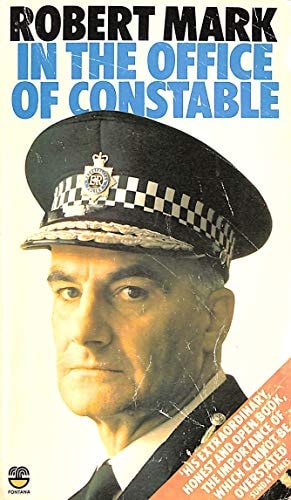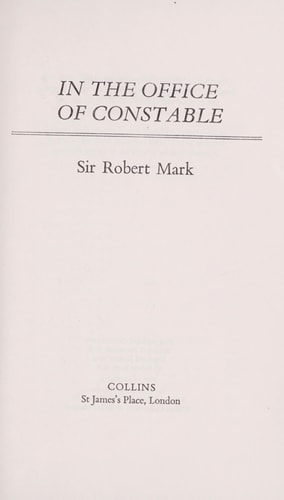
In the Office of Constable
0
0
As an Amazon Associate and affiliate partner, Menrva Books earns from qualifying purchases. Learn more
Author Description
Sir Robert Mark's achievement as Commissioner of the Metropolitan Police is one of the great success stories of our national life. Not only did he root out corruption that was firmly entrenched in the CID, he led his men to a series of brilliant victories against terrorism and violent crime. The sieges of Spaghetti House and Balcombe Street are models that have been studied and admired by police forces the world over. Such a record of practical success would have been enough for most men. But as this book shows, Sir Robert fought hardest over questions of principle. Is the jury system, indeed the whole adversary system of criminal justice, satisfactory or does it make life altogether too easy for the men who organize professional crime? What remedy, if any, have society and the police against the deliberate misuse of legal privilege by unscrupulous lawyers? Above all, what is the function of the police and to whom should they be answerable now that so great a part of their effort is directed towards containing violence that is social and political rather than criminal in its aims and origins? Like the police he so ably defended when politicians or media men tried to misrepresent them, Sir Robert reveals himself in this book as an inextricable combination of the high-minded and the earthy, the idealist and the practical man. The police are, and in his view ought to be, independent of political control. They are there to hold the ring of democratic argument and they rely for their effectiveness on the decent instincts and civilized standards of the people they represent and defend.
Menrva's Summary
THE THESIS
This work examines the fundamental tension between the operational independence of the police force and the evolving demands of a democratic society facing modern crime and political violence. Sir Robert Mark, former Commissioner of the Metropolitan Police, draws upon his extensive career to evaluate the efficacy of the British criminal justice system. He argues that the police must remain insulated from political interference to effectively maintain order, while simultaneously addressing the systemic challenges posed by professional criminals and the legal mechanisms that protect them.
THE SCOPE MAP
What You Will Find
- Historical analysis of the Metropolitan Police during the 1970s.
- Detailed accounts of high-profile operations including the Spaghetti House and Balcombe Street sieges.
- Critical evaluation of the jury system and legal privilege in criminal proceedings.
- Philosophical arguments regarding the role of police in containing social and political violence.
THE AUTHORITY PERSPECTIVE
This text provides a candid, first-hand account of the administrative and ethical challenges faced by high-level law enforcement in the late twentieth century. The narrative reflects a pragmatic, institutional perspective on the necessity of police autonomy within a democratic framework.
Page Count:
320
Publication Date:
1978-01-01
Publisher:
Collins
ISBN-10:
0002160323
ISBN-13:
9780002160322
Biography
Autobiography
History
True Crime
Politics
Law Enforcement
Police
Community Tags
Similar Books