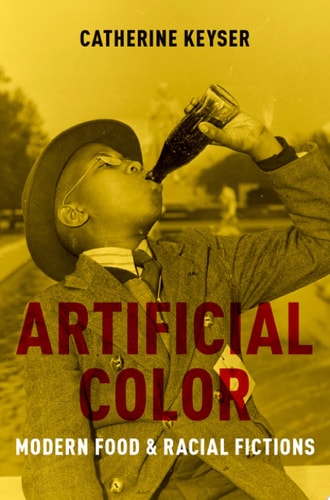
Artificial Color: Modern Food and Racial Fictions
0
0
As an Amazon Associate and affiliate partner, Menrva Books earns from qualifying purchases. Learn more
Author Description
In Artificial Color, Catherine Keyser examines the early twentieth century phenomenon, wherein US writers became fascinated with modern food--global geographies, nutritional theories, and technological innovations. African American literature of the 1920s and 1930s uses new food technologies as imaginative models for resisting and recasting oppressive racial categories. In his masterwork Cane (1923), Jean Toomer follows sugar from the boiling-pots of the South to the speakeasies of the North. Through effervescent and colorful soda, he rejects the binary of black and white in favor of a dream of artificial color and a new American race. In his serial science fiction, Black Empire (1938-39), George Schuyler associates hydroponics and raw foods with racial hybridity and utopian futures. The second half of the book focuses on white expatriate writers who experienced local food cultures as sensuous encounters with racial others. Ernest Hemingway and Gertrude Stein associate regional European races with the ideal of terroir and aspire to transplantation through their own connoisseurship. In their novels set in the Mediterranean, F. Scott and Zelda Fitzgerald both dramatize the white body's susceptibility to intoxicating and stimulating substances like wine and coffee. For Scott Fitzgerald, the climatological and culinary corruption of the South produces the tragic fall of white masculinity. For Zelda, by contrast, it exposes the destructiveness and fictitiousness of the white feminine purity ideal. During the Great Depression and the Second World War, African American writers Zora Neale Hurston and Dorothy West exposed the racism that shaped the global food industry and the precarity of black labor. Their engagement with food, however, insisted upon pleasure as well as vulnerability, the potential of sensuous flesh and racial affiliation. In its embrace of invention and interconnection, Catherine Keyser contends, this modern fiction reveals that, far from being stable, wh
Menrva's Summary
THE THESIS
How did early twentieth-century American writers utilize the evolving landscape of modern food production and consumption to challenge or reinforce racial constructs? Catherine Keyser, an associate professor of English, investigates the intersection of nutritional science, global food geography, and racial identity in the literature of the 1920s through the 1940s. She argues that food serves as a critical site where authors negotiated the stability of racial categories, using culinary metaphors to either uphold or dismantle existing social hierarchies.
THE SCOPE MAP
What You Will Find
- Analysis of African American literature including Jean Toomer’s Cane and George Schuyler’s Black Empire.
- Examination of white expatriate writers such as Ernest Hemingway, Gertrude Stein, and F. and Zelda Fitzgerald.
- Exploration of the impact of the Great Depression and World War II on the global food industry and labor.
- Theoretical frameworks linking food technology, hydroponics, and terroir to racial hybridity and identity.
Scope Limits
- The study focuses primarily on US-centric perspectives and specific literary figures rather than a comprehensive history of the global food industry.
- It does not provide an exhaustive survey of all food-related literature of the era, concentrating instead on works that explicitly engage with racial themes.
THE AUTHORITY PERSPECTIVE
Scholars in the fields of food studies and American literary history note the text's ability to bridge the gap between material culture and abstract racial theory. Experts highlight this work as a significant contribution to understanding how modernist writers utilized the sensory and technological aspects of food to navigate the complexities of identity.
Page Count:
232
Publication Date:
2018-01-01
Publisher:
Oxford University Press
ISBN-10:
0190673141
ISBN-13:
9780190673147
History
English & College Success
American
In literature
Whites
Literary Criticism
Food Studies
English
Race & Ethnicity
Ethnic Studies
Community Tags
Similar Books