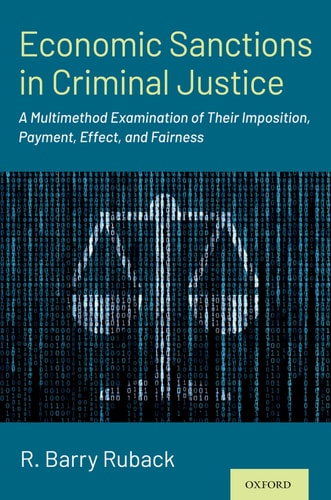
Economic Sanctions in Criminal Justice: A Multimethod Examination of Their Imposition, Payment, Effect, and Fairness
0
0
As an Amazon Associate and affiliate partner, Menrva Books earns from qualifying purchases. Learn more
Author Description
Economic sanctions are court-imposed financial obligations aimed at punishing offenders (fines), funding the government (costs/fees, forfeitures), and compensating victims (restitution). These sanctions have been at the forefront of criminal justice reform in the past few years, and major legal and policy developments concerning such sanctions are under way across the country.Economic Sanctions in Criminal Justice provides an in-depth overview on how economic sanctions are currently being used in the United States to address the multiple goals of criminal sentencing. Featuring 15 empirical studies conducted in Pennsylvania by author R. Barry Ruback, the book investigates the societal, legal, and psychological impacts of economic sanctions in sentencing and corrections, including punishment, reintegration into the community, and the treatment of crime victims. The book analyzes judges' and probation officers' decision-making when imposing and monitoring economic sanctions, and it examines how paying these financial obligations relates to offenders' recidivism. These analyses are tied to the issues of poverty and its intersection with race, including the disproportionate burden of sanctions placed on minority groups. Ending with opportunities for future research and alternatives to monetary sanctions, Economic Sanctions in Criminal Justice is a go-to resource for researchers and professionals in the fields of legal psychology, criminal justice, and law advocating for what is fair and effective for victims, offenders, and society.
Menrva's Summary
THE THESIS
This book investigates the multifaceted role of court-imposed economic sanctions in the United States criminal justice system, questioning their efficacy, fairness, and impact on recidivism. R. Barry Ruback, a professor of criminology and sociology, utilizes a decade of empirical research to evaluate how financial obligations function as tools for punishment, government revenue, and victim restitution. The work presents a comprehensive framework for understanding the intersection of legal sentencing practices with socioeconomic factors like poverty and race.
THE SCOPE MAP
What You Will Find
- Fifteen empirical studies conducted within the Pennsylvania criminal justice system.
- Analysis of decision-making processes utilized by judges and probation officers.
- Quantitative data regarding the correlation between financial payment and recidivism rates.
- Examination of the disproportionate impact of monetary sanctions on minority populations.
Scope Limits
- The research is geographically restricted to Pennsylvania, which may limit the generalizability of findings to other state jurisdictions.
- The text focuses primarily on the administrative and psychological impacts of sanctions rather than providing a comprehensive legal history of fine structures.
THE AUTHORITY PERSPECTIVE
Experts in the field of criminology identify this work as a significant contribution to the empirical study of criminal sentencing and fiscal policy. Readers frequently note the academic density of the prose, which serves as a rigorous resource for researchers and policy professionals examining the intersection of law and social inequality.
Page Count:
624
Publication Date:
2021-01-01
Publisher:
Oxford University Press
ISBN-10:
0190682604
ISBN-13:
9780190682606
Public Policy
Sociology
Law
Criminology
Community Tags
Similar Books