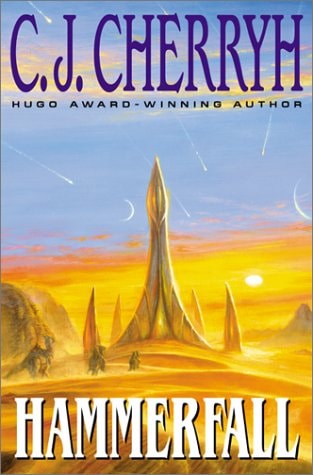
Hammerfall
0
0
As an Amazon Associate and affiliate partner, Menrva Books earns from qualifying purchases. Learn more
Author Description
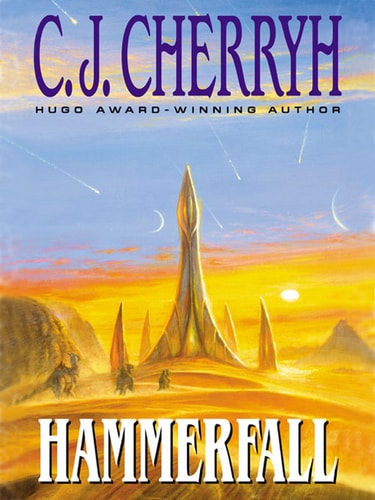
One of science fiction's greatest writers -- a three-time Hugo Award winner -- introduces an all-new universe for the first time in decades. An innocent desert world is trapped between two hostile interstellar empires.One of the most renowned figures in science fiction, C. J. Cherryh has been enthralling audiences for nearly thirty years with rich and complex novels. Now at the peak of her career, this three-time Hugo Award Winner launches her most ambitious work in decades, Hammerfall, part of a far-ranging series, The Gene Wars, set in an entirely new universe scarred by the most vicious of future weaponry, nanotechnology. In this brilliant novel -- possibly Cherryh's masterwork -- the fate of billions has come down to a confrontation between two profoundly alien cultures on a single desert planet.
Menrva's Summary
THE PULSE
A desert world becomes the focal point of a high-stakes conflict between two competing interstellar empires wielding advanced nanotechnology. Marak, a local leader, finds his people caught in the crossfire of forces far beyond their technological comprehension. As these alien powers vie for dominance, he must navigate the shifting political and physical landscape to ensure the survival of his civilization. The narrative utilizes a third-person perspective to track the collision of primitive survival strategies with the cold, calculated logic of post-human warfare. The world is defined by its harsh environment and the looming threat of microscopic weapons that can reshape reality at will.
INSIDE THE PAGES
- Exploration of nanotechnology as a weapon of mass destruction
- Clash between low-tech indigenous culture and high-tech interstellar empires
- Focus on political maneuvering and strategic survival
- Detailed world-building centered on a desert ecosystem
- Examination of the ethics of god-like technological power
- Pacing that emphasizes slow-burn tension and gradual revelation
- Complex character dynamics within a rigid social hierarchy
- Integration of alien cultural perspectives and motivations
THE COLLECTIVE ECHO
Readers frequently highlight the dense, intricate world-building that characterizes this entry into the Gene Wars series. Discussion often centers on the author's ability to balance the grand scale of interstellar conflict with the immediate, grounded struggles of the desert inhabitants. Critics often point to the slow, methodical pacing as a deliberate choice to emphasize the overwhelming nature of the technology involved. Many readers appreciate the lack of clear moral binaries, noting that the alien factions operate under logic systems that are difficult for the human characters to decipher. The narrative is often cited for its focus on the consequences of technological advancement rather than purely action-oriented tropes.
Page Count:
464
Publication Date:
2009-03-01
Publisher:
HarperCollins
ISBN-10:
0060010711
ISBN-13:
9780060010713
Science Fiction
Space Opera
Military Science
Science Fiction
Nanotechnology
Community Tags
Similar Books