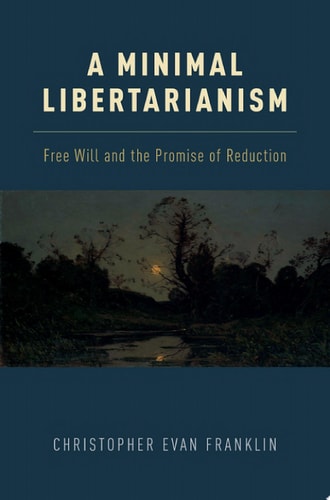
A Minimal Libertarianism
0
0
As an Amazon Associate and affiliate partner, Menrva Books earns from qualifying purchases. Learn more
Author Description
In This Book, Christopher Evan Franklin Develops And Defends A Novel Version Of Event-causal Libertarianism. This View Is A Combination Of Libertarianism--the View That Humans Sometimes Act Freely And That Those Actions Are The Causal Upshots Of Nondeterministic Processes--and Agency Reductionism--the View That The Causal Role Of The Agent In Exercises Of Free Will Is Exhausted By The Causal Role Of Mental States And Events (e.g., Desires And Beliefs) Involving The Agent. Franklin Boldly Counteracts A Dominant Theory That Has Similar Aims, Put Forth By Well-known Philosopher Robert Kane. Many Philosophers Contend That Event-causal Libertarians Have No Advantage Over Compatibilists When It Comes To Securing A Distinctively Valuable Kind Of Freedom And Responsibility. To Franklin, This Position Is Mistaken. Assuming Agency Reductionism Is True, Event-causal Libertarians Need Only Adopt The Most Plausible Compatibilist Theory And Add Indeterminism At The Proper Juncture In The Genesis Of Human Action. The Result Is Minimal Event-causal Libertarianism: A Model Of Free Will With The Metaphysical Simplicity Of Compatibilism And The Intuitive Power Of Libertarianism. And Yet A Worry Remains: Toward The End Of The Book, Franklin Reconsiders His Assumption Of Agency Reductionism, Arguing That This Picture Faces A Hitherto Unsolved Problem. This Problem, However, Has Nothing To Do With Indeterminism Or Determinism, Or Even Libertarianism Or Compatibilism, But With How To Understand The Nature Of The Self And Its Role In The Genesis Of Action. Crucially, If This Problem Proves Unsolvable, Then Not Only Is Event-causal Libertarianism Untenable, So Also Is Event-causal Compatibilism.
Menrva's Summary
THE THESIS
This book investigates whether a coherent model of free will can be constructed by combining event-causal libertarianism with agency reductionism. Christopher Evan Franklin, a scholar in the philosophy of action, utilizes metaphysical analysis to argue that event-causal libertarians can successfully integrate indeterminism into compatibilist frameworks. He challenges existing theories, specifically those proposed by Robert Kane, to demonstrate that a minimalist approach provides a robust account of human agency and moral responsibility.
THE SCOPE MAP
What You Will Find
- A defense of minimal event-causal libertarianism as a viable metaphysical position.
- A critical comparison between event-causal libertarianism and traditional compatibilist theories.
- An examination of the role of mental states, such as beliefs and desires, in the genesis of human action.
Scope Limits
- The text does not provide a comprehensive history of all libertarian theories.
- The analysis does not resolve the ultimate nature of the self, but rather identifies it as a critical problem for both libertarian and compatibilist models.
THE AUTHORITY PERSPECTIVE
Philosophers and students of metaphysics frequently note the technical density of Franklin's prose and his rigorous engagement with contemporary debates on agency. Experts highlight this work as a significant contribution to the literature on free will, particularly for its attempt to bridge the gap between compatibilist simplicity and libertarian intuition.
Page Count:
304
Publication Date:
2018-01-01
Publisher:
Oxford University Press
ISBN-10:
0190682795
ISBN-13:
9780190682798
Philosophy
Agency Theory
Metaphysics
Free Will
Libertarianism
Ethics
Community Tags
Similar Books