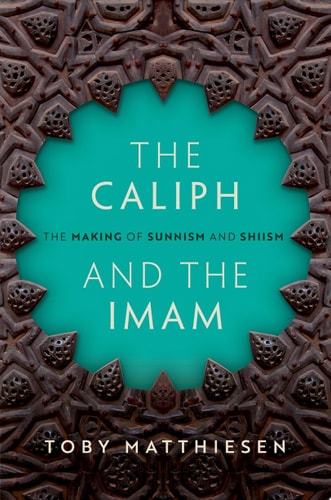
The Caliph and the Imam: The Making of Sunnism and Shiism
0
0
As an Amazon Associate and affiliate partner, Menrva Books earns from qualifying purchases. Learn more
Author Description
The authoritative account of Islam's schism that for centuries has shaped events in the Middle East and the Islamic world.In 632, soon after the Prophet Muhammad died, a struggle broke out among his followers as to who would succeed him. Most Muslims argued that the leader of Islam should be elected by the community's elite and rule as Caliph. They would later become the Sunnis. Others―who would become known as the Shia―believed that Muhammad had designated his cousin and son-in-law Ali as his successor, and that henceforth Ali's offspring should lead as Imams. This dispute over who should guide Muslims, the Caliph or the Imam, marks the origin of the Sunni-Shii split in Islam.Toby Matthiesen explores this hugely significant division from its origins to the present day. Moving chronologically, his book sheds light on the many ways that it has shaped the Islamic world, outlining how over the centuries Sunnism and Shiism became Islam's two main branches, and how Muslim Empires embraced specific sectarian identities. Focussing on connections between the Indian subcontinent and the Middle East, it reveals how colonial rule and the modern state institutionalised sectarian divisions and at the same time led to pan-Islamic resistance and Sunni and Shii revivalism. It then focuses on the fall-out from the 1979 revolution in Iran and the US-led military intervention in Iraq. As Matthiesen shows, however, though Sunnism and Shiism have had a long and antagonistic history, most Muslims have led lives characterised by confessional ambiguity and peaceful co-existence. Tensions arise when sectarian identity becomes linked to politics.Based on a synthesis of decades of scholarship in numerous languages, The Caliph and the Imam will become the standard text for readers looking for a deeper understanding of contemporary sectarian conflict and its historical roots.
Menrva's Summary
THE THESIS
This work investigates the historical origins and evolution of the Sunni-Shii schism, questioning how a dispute over leadership succession transformed into the defining sectarian divide of the Islamic world. Toby Matthiesen, a scholar of Middle Eastern history, synthesizes decades of academic research to trace the development of these two branches from the death of the Prophet Muhammad to the modern era. He argues that while sectarian identities were often fluid, they were increasingly institutionalized by colonial powers and modern state-building projects, ultimately linking religious identity to political conflict.
THE SCOPE MAP
What You Will Find
- A chronological analysis of the Sunni-Shii split from 632 CE to the present day.
- Examination of the impact of colonial rule and modern state formation on sectarian institutionalization.
- Analysis of the 1979 Iranian Revolution and the post-2003 Iraq conflict as catalysts for contemporary tensions.
- Discussion of the historical prevalence of confessional ambiguity and peaceful coexistence among Muslim populations.
Scope Limits
- The text does not provide an exhaustive theological comparison of all Sunni and Shii doctrines.
- The analysis focuses primarily on the intersection of sectarian identity with political power rather than purely private religious practice.
THE AUTHORITY PERSPECTIVE
Scholars and reviewers recognize this volume as a comprehensive and balanced synthesis of complex historical developments. Readers frequently note the accessibility of the prose despite the academic depth, making it a primary resource for understanding the roots of modern sectarian politics.
Page Count:
960
Publication Date:
2023-03-09
Publisher:
Oxford University Press
ISBN-10:
0190689463
ISBN-13:
9780190689469
Politics
Religion
History
Sociology
World politics
Islamic sects
Middle Eastern
New Used & Rental Textbooks
Islamic Empire
Islam
Community Tags
Similar Books