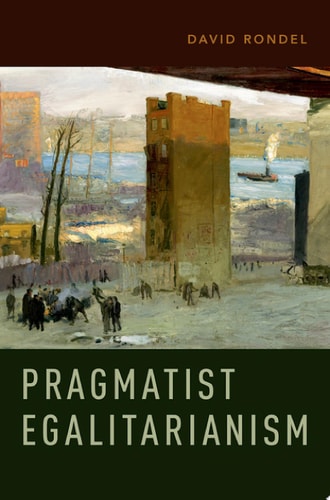
Pragmatist Egalitarianism
0
0
As an Amazon Associate and affiliate partner, Menrva Books earns from qualifying purchases. Learn more
Author Description
Pragmatist Egalitarianism argues that a deep impasse plagues philosophical egalitarianism, and sets forth a novel conception of equality rooted in American pragmatist thought that successfully mediates it.There is a division within egalitarianism between those who regard equality as a fundamentally distributive ideal and those who construe it as a normative conception of human relationships. Despite their close connection, these different ideals may come apart. And yet, so much philosophical writing on equality is marked by what looks like a zero-sum competition for the same conceptual turf, as if the whole truth about equality must be captured by a single idea or an exclusive set of principles.One of the core arguments in Pragmatist Egalitarianism is that we should reject the central premises upon which such disagreement turns: that equality is a single idea, that it has a fundamental locus, and that there is a singular or primary route to the achievement of a genuinely egalitarian society. David Rondel argues for a recasting of egalitarianism in light of three mutually reinforcing variables--the Institutional, the Personal, and the Cultural--each of which is best accentuated in one of a trio of pragmatists. If the three variables are mutually complicit in promoting inequality, an egalitarianism that takes this seriously will treat all three as equally (albeit differently) important in making things better.Infused with the thought of leading American pragmatists, including William James, John Dewey, and Richard Rorty, Pragmatist Egalitarianism puts pragmatist philosophy to work in new and profoundly illuminating ways.
Menrva's Summary
THE THESIS
This book investigates the persistent impasse within philosophical egalitarianism by challenging the assumption that equality must be defined by a single, exclusive principle. David Rondel, a scholar of political philosophy, utilizes the framework of American pragmatism to argue that equality is not a monolithic concept. By synthesizing the works of William James, John Dewey, and Richard Rorty, the author proposes a tripartite model of egalitarianism that addresses institutional, personal, and cultural dimensions simultaneously.
THE SCOPE MAP
What You Will Find
- A critique of the distributive versus relational divide in egalitarian theory.
- A tripartite framework for equality involving institutional, personal, and cultural variables.
- Application of pragmatist philosophy to contemporary social and political problems.
Scope Limits
- The text does not provide a comprehensive history of all egalitarian thought.
- It does not offer a specific policy manual for legislative implementation.
THE AUTHORITY PERSPECTIVE
Scholars in political theory recognize this work as a significant contribution to the intersection of pragmatism and social justice. Readers frequently note the academic density of the prose, which is intended for an audience familiar with contemporary philosophical debates.
Page Count:
240
Publication Date:
2018-01-02
Publisher:
Oxford University Press
ISBN-10:
0190680687
ISBN-13:
9780190680688
Philosophy
Pragmatism
Political Philosophy
Political Theory
Community Tags
Other Editions(3)

Similar Books
Reader Comments
Share Your Thoughts
No comments yet. Be the first to share your thoughts!