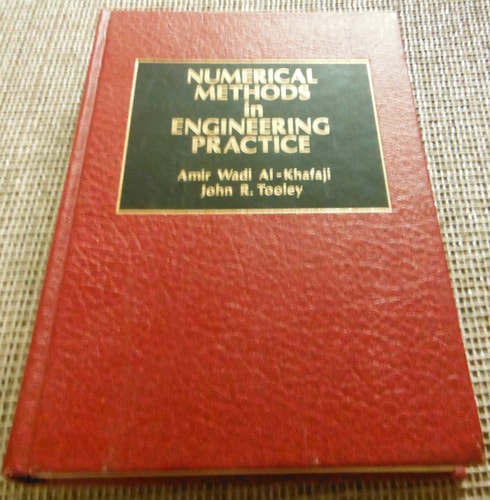
Numerical Methods in Engineering Practice (Hrw Series in Mechanical Engineering)
0
0
As an Amazon Associate and affiliate partner, Menrva Books earns from qualifying purchases. Learn more
Author Description
Numerical Methods in Engineering Practice aims to introduce numerical techniques in engineering and the related topics in applied mathematics early in an engineer's undergraduate education. A comprehensive and detailed treatment of classical and contemporary numerical methods this text emphasizes how to apply these methods to solve "real-world" engineering problems. The text bridges the gap between theory and practice with over 300 practical problems drawn from civil, mechanical and electrical engineering. Its broad topical coverage ranges from elementary matrix algebra to systems of partial differential equations, including many unique topics such as linear and non-linear optimization, easy to understand treatment of cubic spines, and Eigenvalue technique for solving systems of partial differential equations.
Menrva's Summary
THE THESIS
This text investigates how to effectively integrate numerical analysis techniques into the undergraduate engineering curriculum to solve complex, real-world problems. Authors Amir Wadi Al-Khafaji and John R. Tooley provide a structured pedagogical framework that connects theoretical mathematical concepts with practical engineering applications. By utilizing a wide array of disciplinary examples, the authors argue that early exposure to these computational methods is critical for modern engineering proficiency.
THE SCOPE MAP
What You Will Find
- Comprehensive coverage of matrix algebra and systems of partial differential equations
- Specialized instruction on linear and non-linear optimization
- Practical application of cubic splines and Eigenvalue techniques
- Over 300 engineering-specific problems spanning civil, mechanical, and electrical fields
Scope Limits
- The text focuses primarily on undergraduate-level applications and does not address advanced research-grade computational fluid dynamics or high-performance computing architectures
THE AUTHORITY PERSPECTIVE
Experts and educators frequently cite this text as a reliable resource for bridging the gap between abstract mathematics and applied engineering. Readers often note the clarity of the examples provided, which makes the material accessible for students transitioning from introductory calculus to specialized engineering coursework.
Page Count:
656
Publication Date:
1995-06-08
Publisher:
Oxford University Press
ISBN-10:
0030017572
ISBN-13:
9780030017575
Engineering
Science & Math
Technology
textbook
New Used & Rental Textbooks
Numerical analysis
Applied Mathematics
Mathematics
Community Tags
Similar Books