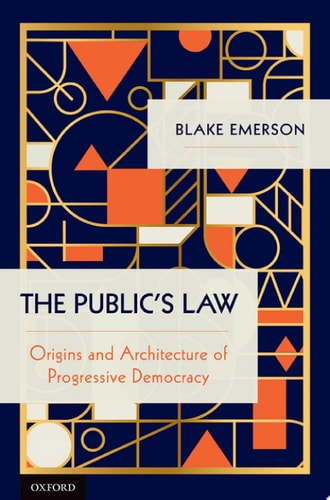
The Public's Law: A Theory and History of Democracy in the American Administrative State
0
0
As an Amazon Associate and affiliate partner, Menrva Books earns from qualifying purchases. Learn more
Author Description
The Public's Law Is A Theory And History Of Democracy In The American Administrative State. The Book Describes How American Progressive Thinkers - Such As John Dewey, W.e.b. Du Bois, And Woodrow Wilson - Developed A Democratic Understanding Of The State From Their Study Of Hegelian Political Thought. G.w.f. Hegel Understood The State As An Institution That Regulated Society In The Interest Of Freedom. This Normative Account Of The State Distinguished His View From Later German Theorists, Such As Max Weber, Who Adopted A Technocratic Conception Of Bureaucracy, And Others, Such As Carl Schmitt, Who Prioritized The Will Of The Chief Executive. The Progressives Embraced Hegel's View Of The Connection Between Bureaucracy And Freedom, But Sought To Democratize His Concept Of The State. They Agreed That Welfare Services, Economic Regulation, And Official Discretion Were Needed To Guarantee Conditions For Self-determination. But They Stressed That The People Should Participate Deeply In Administrative Policymaking. This Progressive Ideal Influenced Administrative Programs During The New Deal. It Also Sheds Light On Interventions In The War On Poverty And The Second Reconstruction, As Well As On The Administrative Procedure Act Of 1946. The Book Develops A Normative Theory Of The State On The Basis Of This Intellectual And Institutional History, With Implications For Deliberative Democratic Theory, Constitutional Theory, And Administrative Law. On This View, The Administrative State Should Provide Regulation And Social Services Through Deliberative Procedures, Rather Than Hinge Its Legitimacy On Presidential Authority Or Economistic Reasoning.
Menrva's Summary
THE THESIS
The Public's Law investigates how American Progressive thinkers synthesized Hegelian political philosophy to construct a democratic framework for the modern administrative state. Blake Emerson, a legal scholar, examines the intellectual lineage connecting 19th-century German political thought to the development of American administrative institutions. By analyzing the works of figures like John Dewey, W.E.B. Du Bois, and Woodrow Wilson, the author argues that the administrative state was originally conceived as a mechanism to secure individual freedom through public participation rather than mere technocratic control. The text posits that this historical perspective offers a normative foundation for contemporary debates regarding administrative legitimacy and democratic governance.
THE SCOPE MAP
What You Will Find
- An intellectual history of the American administrative state from the Progressive Era through the New Deal.
- A comparative analysis of Hegelian political theory versus the technocratic models of Max Weber and the executive-centric views of Carl Schmitt.
- A normative theory of administrative law that emphasizes deliberative procedures over presidential authority or economistic reasoning.
Scope Limits
- The book does not provide a comprehensive legal manual for current administrative practice or litigation strategies.
- The analysis focuses primarily on the intellectual and institutional history of the United States, rather than a global comparative study of bureaucracy.
THE AUTHORITY PERSPECTIVE
Scholars and legal theorists frequently cite this work as a significant contribution to the history of American political thought and administrative law. Readers often note the academic density of the prose, which requires a foundational understanding of political philosophy to fully appreciate the author's arguments.
Page Count:
304
Publication Date:
2019-01-01
Publisher:
Oxford University Press
ISBN-10:
0190682884
ISBN-13:
9780190682880
History
American Government
Administrative Law
Jurisprudence
Law
Political Theory
Systems Theory
Community Tags
Similar Books