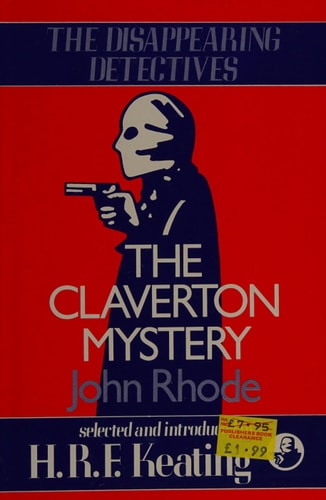
The Claverton Mystery
0
0
As an Amazon Associate and affiliate partner, Menrva Books earns from qualifying purchases. Learn more
Author Description
No. 13 Beaumaris Place was the last remaining private residence in a street long since given up to apartment houses. Dr Lancelot Priestley was all too familiar with its rather gloomy interior, for he had been in the habit of calling there to see its owner, his old friend Sir John Claverton, though circumstances had prevented him from visiting for some time. When he did at last call again at No. 13 it was to find Sir John ill and his doctor uneasy. On a second visit he was informed that Sir John had died suddenly the day before. The family physician was not the only person to find circumstances which seemed to him suspicious, and after consultation with Dr Priestley there was little doubt in anyone's mind that Sir John Claverton was poisoned. Nevertheless, the case presented several baffling aspects, but by ingenious deductions from slender clues Dr Priestley eventually succeeded in finding a satisfactory solution to the case that became famous as The Claverton Mystery.
Menrva's Summary
THE PULSE
When Dr. Lancelot Priestley discovers that his friend Sir John Claverton has died under suspicious circumstances, he must navigate a web of family secrets to uncover the truth behind a suspected poisoning. Priestley, a man of sharp intellect and methodical habits, finds himself at odds with the initial medical assessment of his friend's sudden demise. He must contend with a household of potential suspects and a series of baffling, seemingly contradictory clues that obscure the killer's identity. The narrative follows a traditional investigative framework, emphasizing the logical deconstruction of evidence rather than high-octane action.
INSIDE THE PAGES
- Traditional locked-room style atmosphere within a private residence
- Emphasis on logical deduction and forensic reasoning
- Focus on the intellectual prowess of the protagonist, Dr. Lancelot Priestley
- Exploration of social dynamics within a wealthy, aging household
- Systematic elimination of suspects through careful observation
- Pacing centered on the gradual accumulation of subtle clues
- Classic Golden Age mystery structure
- Analytical approach to medical and circumstantial evidence
THE COLLECTIVE ECHO
The work reflects the hallmarks of the Golden Age of detective fiction, prioritizing cerebral puzzle-solving over visceral thrills. Readers familiar with the genre will recognize the methodical, almost clinical approach that defines the Dr. Priestley series. The narrative relies heavily on the protagonist's ability to synthesize disparate facts into a coherent explanation for an otherwise inexplicable death. It serves as a representative example of the period's fascination with the intellectual triumph of the amateur detective over complex criminal schemes.
Page Count:
192
Publication Date:
1985-04-15
Publisher:
HarperCollins Publishers
ISBN-10:
0002314231
ISBN-13:
9780002314237
Mystery
Classic Crime
Detective
Crime & mystery
Community Tags
Similar Books