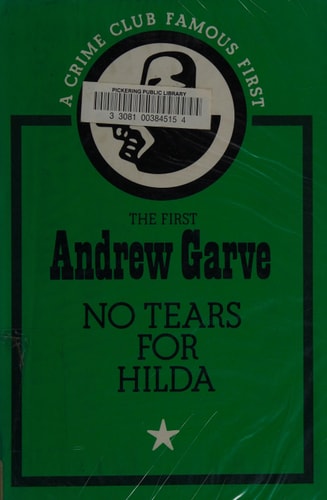
No Tears for Hilda
0
0
As an Amazon Associate and affiliate partner, Menrva Books earns from qualifying purchases. Learn more
Author Description
When Max Easterbrook arrived in London on a month's leave, he was astounded to find George Lambert, his best friend, in prison on a charge of wife-murder. The police were satisfied that here was a clear case of the eternal triangle; no need to look far for the murderer, for George was not exactly weeping tears at his wife's sad demise. But Max was sure George was not the man to murder one woman in order to marry another. He was not nearly so sure that the large and lazy Hilda was not a natural murderee.
Menrva's Summary
THE PULSE
When Max Easterbrook returns to London to find his best friend George Lambert accused of murdering his wife, he must navigate a web of suspicion to prove George's innocence. Max is convinced that George lacks the temperament for such a crime, despite the police's confidence in a motive involving a romantic triangle. He faces the challenge of investigating the victim, Hilda, whose own behavior and personality suggest she may have been a catalyst for her own demise. The narrative unfolds as a classic investigation, focusing on Max's efforts to uncover the truth behind the domestic tragedy.
INSIDE THE PAGES
- Classic whodunit structure centered on a domestic murder investigation
- Protagonist-led inquiry that challenges official police conclusions
- Exploration of the 'eternal triangle' trope as a primary motive
- Focus on character psychology and the victim's personal history
- Pacing consistent with mid-century British detective fiction
- Emphasis on logical deduction over high-octane action
- Setting grounded in the social atmosphere of London
- Third-person narrative perspective providing insight into Max's reasoning
THE COLLECTIVE ECHO
This work is regarded as a quintessential example of mid-century British detective fiction, noted for its focus on character dynamics rather than mere procedural mechanics. The premise suggests a narrative that prioritizes the psychological profile of the victim and the accused over complex forensic science. Readers often appreciate the author's ability to construct a plausible defense for a seemingly guilty party, maintaining suspense through careful observation. The genre conventions point to a tightly plotted mystery that relies on the protagonist's intuition to dismantle the prosecution's case.
Page Count:
228
Publication Date:
1981-01-01
Publisher:
Collins
ISBN-10:
0002316846
ISBN-13:
9780002316842
Mystery
Crime
Suspense
Mystery & Detective
Fiction
Detective
Classic Crime
Community Tags
Similar Books