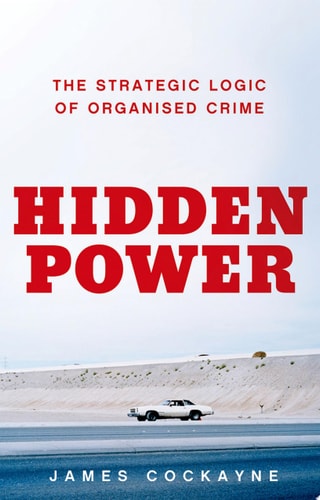
Hidden Power: The Strategic Logic of Organized Crime
0
0
As an Amazon Associate and affiliate partner, Menrva Books earns from qualifying purchases. Learn more
Author Description
What should we make of the outsized role organized crime plays in conflict and crisis, from drug wars in Mexico to human smuggling in North Africa, from the struggle in Crimea to scandals in Kabul? How can we deal with the convergence of politics and crime in so-called 'mafia states' such as Guinea-Bissau, North Korea or, as some argue, Russia? Drawing on unpublished government documents and mafia memoirs, James Cockayne discovers the strategic logic of organized crime, hidden in a century of forgotten political--criminal collaboration in New York, Sicily and the Caribbean. He reveals states and mafias competing - and collaborating -- in a competition for governmental power. He discovers mafias influencing elections, changing constitutions, organizing domestic insurgencies and transnational terrorism, negotiating peace deals, and forming governmental joint ventures with ruling groups. And he sees mafias working with the US government to spy on American citizens, catch Nazis, try to assassinate Fidel Castro, invade and govern Sicily, and playing unappreciated roles in the Bay of Pigs fiasco and the Cuban Missile Crisis.
Menrva's Summary
THE THESIS
This book investigates the strategic logic behind the convergence of organized crime and state power, questioning how criminal entities influence global conflict and governance. James Cockayne, a researcher specializing in international security and transnational crime, utilizes a combination of declassified government documents and primary source mafia memoirs to construct his argument. He posits that the relationship between states and criminal organizations is not merely parasitic but often collaborative, functioning as a competitive struggle for governmental authority across various historical and geopolitical contexts.
THE SCOPE MAP
What You Will Find
- Historical analysis of political-criminal collaboration in New York, Sicily, and the Caribbean.
- Case studies involving mafia influence on elections, constitutional changes, and insurgencies.
- Examination of covert operations involving the US government and criminal syndicates during the Cold War.
Scope Limits
- The text focuses primarily on the strategic and political dimensions of organized crime rather than the day-to-day operational mechanics of specific criminal enterprises.
- It does not provide a comprehensive global survey of all modern criminal organizations, focusing instead on specific historical and regional examples of state-mafia convergence.
THE AUTHORITY PERSPECTIVE
Experts in international relations and security studies identify this work as a significant contribution to the understanding of the 'mafia state' phenomenon. Readers frequently note the academic density of the prose and the extensive use of archival research to support the author's unconventional claims.
Page Count:
467
Publication Date:
2017-01-01
Publisher:
Oxford University Press
ISBN-10:
0190694815
ISBN-13:
9780190694814
History
Criminology
Sociology
International relations
Community Tags
Similar Books