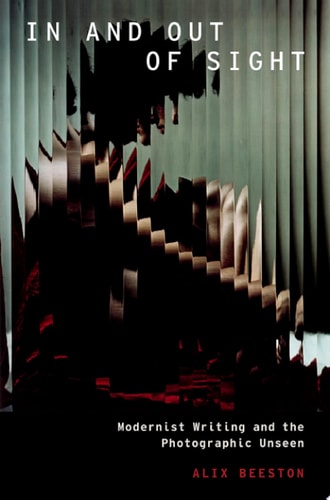
In and Out of Sight: Modernist Writing and the Photographic Unseen
0
0
As an Amazon Associate and affiliate partner, Menrva Books earns from qualifying purchases. Learn more
Author Description
In a post-digital media landscape tracked endlessly by streams and feeds of images, it is clearer than ever that photography is an art poised between arresting singularity and ambiguous plurality. Drawing on work in visual culture studies that emphasizes the interplay between still and moving images, In and Out of Sight provides a provocative new account of the relationship between photography and modernist literature--a literature which has long been considered to trace, in its formal experimentation, the influence of modern visual technologies. Making pioneering claims about the importance of photography to the writing of Gertrude Stein, Jean Toomer, John Dos Passos, and F. Scott Fitzgerald, Alix Beeston traverses the history of photography in the late nineteenth and early twentieth centuries. From the composite experiments of Francis Galton to the epic portrait project of August Sander; from the surrealist self-fashioning of Claude Cahun to the reappropriation of lynching photographs by black activist groups; from the collectable postcards of Broadway stars to the glamour shots of Hollywood celebrities-these and other serialized photographic projects provide essential contexts for understanding the fragmentary, composite forms of literary modernism. In a series of richly detailed literary analyses, Beeston argues that the gaps and intervals of the composite literary text model the visual syntax of photography--as well as its silences, absences, and equivocations. In them, the social and political order of modernity is negotiated and reshaped. Moving in and out of these textual openings, In and Out of Sight pursues the fleeting, visible and invisible figure of the woman-in-series, who recasts absence and silence as forms of presence and witness. This shadowy figure emerges as central to the conceptual space of modernist literature--a terrain not only gendered but radically constructed around the instability of female bodies and their desires.
Menrva's Summary
THE THESIS
This book investigates how the formal structures of early twentieth-century modernist literature were fundamentally shaped by the visual syntax, silences, and composite nature of photography. Alix Beeston, a scholar in modernist literature and visual culture, utilizes a framework that bridges literary analysis with the history of photographic technology. She argues that the gaps and intervals found in the works of authors like Stein, Toomer, Dos Passos, and Fitzgerald mirror the photographic unseen, ultimately revealing how modernity negotiated social and political identity through the representation of the female figure.
THE SCOPE MAP
What You Will Find
- Analysis of the relationship between serialized photographic projects and literary fragmentation.
- Examination of works by Gertrude Stein, Jean Toomer, John Dos Passos, and F. Scott Fitzgerald.
- Historical context ranging from Francis Galton’s composite experiments to the surrealist self-fashioning of Claude Cahun.
- Theoretical exploration of the 'woman-in-series' as a recurring figure of presence and witness.
Scope Limits
- The study does not provide a comprehensive history of all modernist literature, focusing instead on specific authors whose work aligns with the photographic thesis.
- It does not address contemporary digital photography beyond its introductory framing of the post-digital landscape.
THE AUTHORITY PERSPECTIVE
Scholars and critics recognize this work as a significant contribution to the intersection of visual culture and literary studies, particularly for its focus on gendered representations. Readers frequently note the academic density of the prose, which is intended for an audience familiar with modernist theory and visual studies methodologies.
Page Count:
274
Publication Date:
2017-01-01
Publisher:
Oxford University Press
ISBN-10:
0190690186
ISBN-13:
9780190690182
History
Art History
Humanities
English
Modernism
Gender Studies
English & College Success
Academic
PHOTOGRAPHY History
Literary Criticism
Community Tags
Other Editions(2)
Similar Books




Reader Comments
Share Your Thoughts
No comments yet. Be the first to share your thoughts!