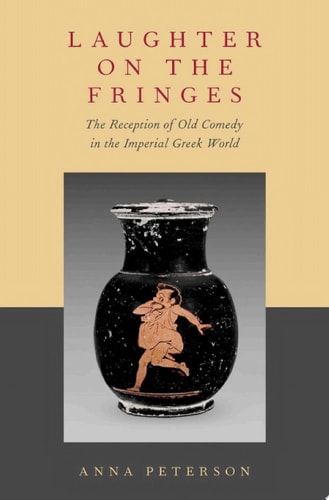
Laughter on the Fringes: The Reception of Old Comedy in the Imperial Greek World
0
0
As an Amazon Associate and affiliate partner, Menrva Books earns from qualifying purchases. Learn more
Author Description
This book examines the impact that Athenian Old Comedy had on Greek writers of the imperial era. It is generally acknowledged that imperial-era Greeks responded to Athenian Old Comedy in one of two ways: either as a treasure trove of Atticisms or as a genre defined by and repudiated for its aggressive humor. Worthy of further consideration, however, is the degree to which both approaches, and particularly the latter one that relegated Old Comedy to the fringes of the literary canon, led authors to engage with the ironic and self-reflexive humor of Aristophanes, Eupolis and Cratinus. Authors ranging from serious moralizers (Plutarch and Aelius Aristides) to comic writers in their own right (Lucian, Alciphron) to other figures not often associated with Old Comedy (Libanius) adopted aspects of the genre to negotiate power struggles, facilitate literary and sophistic rivalries, and as a model for autobiographical writing. To varying degrees, these writers wove recognizable features of the genre (e.g. the parabasis, its agonistic language, the stage biographies of the individual poets) into their writings. The image of Old Comedy that emerges from this time is that of a genre in transition. It was, on the one hand, with the exception of Aristophanes' extant plays, on the verge of being almost completely lost; on the other hand, its reputation and several of its most characteristic elements were being renegotiated and reinvented.
Menrva's Summary
THE THESIS
This book investigates how imperial-era Greek writers engaged with and reinterpreted the legacy of Athenian Old Comedy despite its marginalization within the literary canon. Anna Peterson, a scholar of classical literature, utilizes a comparative analysis of diverse authors—ranging from moral philosophers like Plutarch to satirists like Lucian—to demonstrate how Old Comedy functioned as a flexible model for power negotiation, literary rivalry, and autobiographical expression. The work argues that the genre was not merely a static relic but a dynamic, evolving influence during the imperial period.
THE SCOPE MAP
What You Will Find
- Analysis of the reception of Aristophanes, Eupolis, and Cratinus in the imperial era
- Examination of literary techniques such as the parabasis and agonistic language
- Case studies on authors including Plutarch, Aelius Aristides, Lucian, Alciphron, and Libanius
Scope Limits
- The study focuses primarily on the imperial Greek reception rather than the original performance context of the plays
- It does not provide a comprehensive history of Old Comedy itself, but rather its afterlife in later literature
THE AUTHORITY PERSPECTIVE
Scholars view this text as a significant contribution to the study of classical reception and the evolution of literary canons. Readers frequently note the academic density of the prose, which is tailored for specialists in Hellenistic and imperial Greek literature.
Page Count:
240
Publication Date:
2019-01-01
Publisher:
Oxford University Press
ISBN-10:
0190697113
ISBN-13:
9780190697112
History
Greek drama
Literary Criticism
Comedy
Ancient History
Community Tags
Similar Books