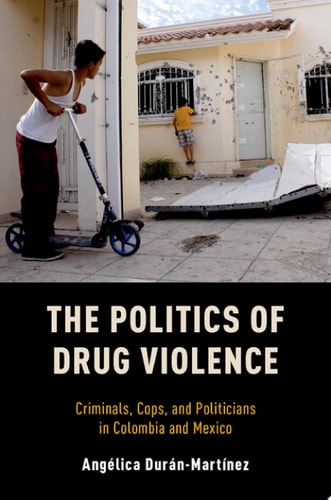
The Politics of Drug Violence: Criminals, Cops and Politicians in Colombia and Mexico
0
0
As an Amazon Associate and affiliate partner, Menrva Books earns from qualifying purchases. Learn more
Author Description
Over the last few decades, drug trafficking organizations in Latin America became infamous for their shocking public crimes, from narcoterrorist assaults on the Colombian political system in the 1980s to the more recent wave of beheadings in Mexico. However, while these highly visible forms of public violence dominate headlines, they are neither the most common form of drug violence nor simply the result of brutality. Rather, they stem from structural conditions that vary from country to country and from era to era. In The Politics of Drug Violence, Angelica Durán-Martínez shows how variation in drug violence results from the complex relationship between state power and criminal competition. Drawing on remarkably extensive fieldwork, this book compares five cities that have been home to major trafficking organizations for the past four decades: Cali and Medellín in Colombia, and Ciudad Juárez, Culiacán, and Tijuana in Mexico. She shows that violence escalates when trafficking organizations compete and the state security apparatus is fragmented. However, when the criminal market is monopolized and the state security apparatus cohesive, violence tends to be more hidden and less frequent. The size of drug profits does not determine violence levels, and neither does the degree of state weakness. Rather, the forms and scale of violent crime derive primarily from the interplay between marketplace competition and state cohesiveness. An unprecedentedly rich empirical account of one of the worst problems of our era, the book will reshape our understanding of the forces driving organized criminal violence in Latin America and elsewhere.
Menrva's Summary
THE THESIS
This book investigates why drug trafficking organizations employ varying levels of public violence across different regions and time periods. Angelica Durán-Martínez, an expert in Latin American politics, challenges the assumption that violence is merely a byproduct of state weakness or high drug profits. Instead, she argues that the scale and visibility of criminal violence are determined by the specific interplay between the cohesiveness of state security apparatuses and the level of competition within criminal markets.
THE SCOPE MAP
What You Will Find
- A comparative analysis of five cities: Cali, Medellín, Ciudad Juárez, Culiacán, and Tijuana.
- A theoretical framework linking state security fragmentation to public criminal violence.
- Extensive empirical data gathered through long-term fieldwork and primary source research.
Scope Limits
- The study focuses primarily on Colombia and Mexico, excluding other Latin American nations affected by drug trafficking.
- The analysis does not address the international demand-side economics of the drug trade.
THE AUTHORITY PERSPECTIVE
Experts recognize this work as a rigorous contribution to the study of organized crime and state-society relations. Readers frequently note the academic density of the prose and the systematic nature of the author's comparative methodology.
Page Count:
328
Publication Date:
2018-01-12
Publisher:
Oxford University Press
ISBN-10:
0190695951
ISBN-13:
9780190695958
Violent Crimes
Crime mexico
International relations
Public Policy
American Studies
Criminology
Politics & Government
Drug Traffic
Sociology
Community Tags
Similar Books