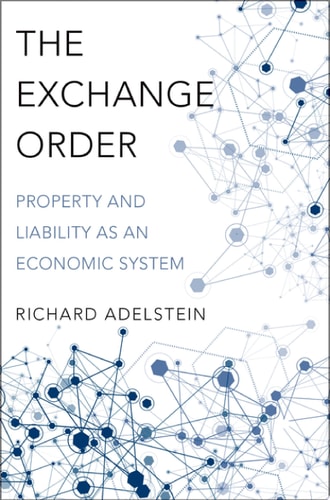
Exchange Order: Property and Liability As an Economic System
0
0
As an Amazon Associate and affiliate partner, Menrva Books earns from qualifying purchases. Learn more
Author Description
There Are Three Basic Institutional Systems For Governing The Exchange Of Property. One Is Consensual: The Exchange Of Property Rights In Ordinary Markets. The Other Two, However, Are Nonconsensual: The Involuntary Exchange Of Entitlements In Either Civil Or Criminal Liability Cases. In The Exchange Order, Richard Adelstein Argues That While Markets, Torts, And Criminal Justice Are Ostensibly Different Constellations Of Institutions, Organizations And Individuals, They Are Remarkably Alike. Each Governs A Particular Kind Of Exchange Through A Distinctive Set Of Institutions, Rules And Procedures. They Have All Evolved Over Many Centuries From The Same Root, A Deep-seated Human Propensity To Communicate With Others Through Trade, To Exchange Goods For Goods And Costs For Costs As A Means Of Reconciling Opposing Interests And Increasing Personal Welfare. They Perform The Same Social Function, Facilitating Individually Efficient Exchanges Of Rights And Compensatory Prices, In Very Different Exchange Environments That Demand Very Different Institutional Responses To The Problem All Three Are In Place To Solve: Identifying Efficient Transfers And Seeing That They Are Completed. The Exchange Order Provides A Sweeping Historical, Comparative, And Philosophical Analysis Of How Rights And Objects, Goods And Harms, Are Exchanged In These Apparently Very Different Realms. What Unites Them Is A Core Norm: Take Only What You Can Pay For, And Pay For Everything You Take. In Markets Free Exchange Is Governed By Prices And The Willingness To Sell Or Buy. Tort And Criminal Law Apply When Consensual Exchange Is Violated. The Violation Is The Non-consensual Seizure Of Entitlements And The Payment Is A Liability Price On The Taker That Compensates The Victim For The Costs Imposed By The Taking. Tit For Tat, An Eye For An Eye, Is The Principle Of Exchange That Unites Markets, Tort And Crime.
Menrva's Summary
THE THESIS
How do markets, tort law, and criminal justice function as a unified system for governing the exchange of property and liability? Richard P. Adelstein, a scholar of law and economics, posits that these three seemingly disparate domains are fundamentally linked by a common social function: the facilitation of efficient exchanges. By analyzing the historical and philosophical evolution of these institutions, the author argues that they all operate under a singular normative principle: take only what you can pay for, and pay for everything you take. This framework seeks to reconcile opposing interests by treating both goods and harms as objects of exchange.
THE SCOPE MAP
What You Will Find
- A comparative analysis of market mechanisms, tort liability, and criminal justice procedures.
- A historical overview of the evolution of property rights and compensatory pricing.
- A philosophical examination of the 'tit for tat' principle across different social environments.
Scope Limits
- The text does not provide a practical guide for legal practitioners or market traders.
- The analysis does not cover specific modern legislative statutes or current case law developments.
THE AUTHORITY PERSPECTIVE
Scholars and readers often note the high level of academic rigor and the interdisciplinary nature of the prose. Experts frequently cite this work as a significant contribution to the field of law and economics for its ability to synthesize disparate institutional frameworks into a coherent theory.
Page Count:
352
Publication Date:
2017-01-01
Publisher:
Oxford University Press, Incorporated
ISBN-10:
0190694289
ISBN-13:
9780190694289
Economics
Legal Theory
property rights
Social Science
Law Philosophy
Law
Property
Community Tags
Similar Books