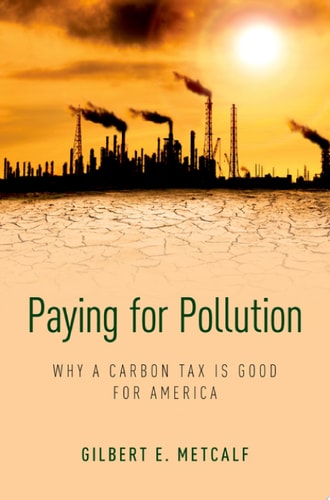
Paying for Pollution: Why a Carbon Tax is Good for America
0
0
As an Amazon Associate and affiliate partner, Menrva Books earns from qualifying purchases. Learn more
Author Description
The threats posed by global climate change are widely recognized and carbon emmissions are the major source of greenhouse gases accumulating in the atmosphere. Burning fossil fuels causes long-lasting, pervasive damages, costly to those of us alive today and even more to our children and our children's children. The United States is the second largest carbon emitting country in the world and should play a key role in global efforts to reduce emissions. Paying for Pollution incisively examines the very real costs-economic and social-of climate change and the challenges of concerted action to reduce future losses due to damages of higher temperatures and more extreme weather. Gilbert E. Metcalf argues that there is a convergence of social, economic, environmental, and political forces that provides an opening for a new approach to climate policy, one based on market principles that can appeal to politicians across the political spectrum. After all, markets work best when the price of a good reflects all its costs.Metcalf suggests that a thoughtfully and politically sensitive designed carbon tax could also contribute to an improved tax system, something desired by Republican and Democratic politicians alike. That is, a carbon tax increases fiscal flexibility by providing new revenues to finance reforms to the income tax that improve the fairness of the tax code and contribute to economic growth. Metcalf compares the benefits of a carbon tax to other potential policies, such as cap and trade, to reduce the threats of climate change. None, he shows, are as effective, efficient, and fair as a carbon tax.
Menrva's Summary
THE THESIS
Can a carbon tax serve as an economically efficient and politically viable solution to mitigate climate change while simultaneously improving the broader tax system? Gilbert E. Metcalf, a professor of economics, utilizes his expertise in energy and tax policy to argue that market-based mechanisms are superior to alternative regulatory frameworks. He posits that by internalizing the social costs of carbon emissions, the United States can achieve significant environmental progress while generating revenue to reform the existing income tax code.
THE SCOPE MAP
What You Will Find
- Comparative analysis of carbon tax versus cap and trade systems
- Economic modeling of social and environmental costs of fossil fuel consumption
- Frameworks for revenue-neutral tax reform
- Political strategies for bipartisan policy adoption
Scope Limits
- Does not provide a comprehensive technical manual for implementation at the state level
- Does not focus on the engineering or technological aspects of carbon capture
THE AUTHORITY PERSPECTIVE
Experts in environmental economics frequently cite this work as a clear, accessible argument for market-based climate policy. Readers often note that the text successfully bridges the gap between complex economic theory and practical political application.
Page Count:
200
Publication Date:
2018-01-01
Publisher:
Oxford University Press
ISBN-10:
0190694211
ISBN-13:
9780190694210
Economics
Air
Climate Change
Public Policy
Taxation
Global warming
Community Tags
Similar Books