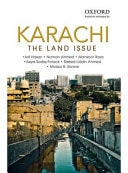
Karachi: The Land Issue
0
0
As an Amazon Associate and affiliate partner, Menrva Books earns from qualifying purchases. Learn more
Author Description
Karachi is one of the fastest growing cities in the world. It is Pakistan's only port and the major contributor to the country's economy. In addition, it is also a diverse city with its population politically divided along ethnic lines. These three factors make the urban land and that on the citys fringe a highly contested commodity: federal, provincial, and local land-owning agencies, corporate sector interests, formal and informal developers, international capital, and military cantonments compete for control and for extracting maximum value from it. The victims of this battle for turf and profits are the city's social and physical environment and its low and lower middle-income groups.This book deals with the history, evolution, and present day realities around who owns land, its legal and illegal acquisition, land-use conversions and development, the actors involved and their relationship with each other and with the public at large, the often violent conflicts that take place in this process and the measures that can be taken to regulate the land market for the creation of a better urban environment and for providing homes to its less privileged.
Menrva's Summary
THE THESIS
This book investigates the complex, often violent competition for urban land control in Karachi, examining how conflicting interests among government agencies, corporate entities, and developers impact the city's social and physical landscape. The authors, a collective of urban researchers and scholars, utilize historical analysis and contemporary case studies to map the power dynamics governing land acquisition in Pakistan's largest economic hub. They argue that the current trajectory of land development prioritizes capital extraction over the needs of low-income residents, resulting in systemic inequality and environmental degradation. The work provides a framework for understanding the intersection of ethnic politics, legal ambiguity, and urban expansion.
THE SCOPE MAP
What You Will Find
- Historical evolution of land ownership and acquisition in Karachi.
- Analysis of the competing interests between federal, provincial, and military land-owning agencies.
- Examination of the impact of formal and informal development on lower-income populations.
- Proposed regulatory measures to improve urban land management.
Scope Limits
- The text focuses primarily on the Karachi metropolitan region and may not apply to other urban centers in Pakistan.
- It does not provide a comprehensive legal manual for individual property rights.
THE AUTHORITY PERSPECTIVE
Experts recognize this work as a critical, data-driven examination of urban governance in the Global South. Readers frequently note the academic density of the prose, which provides a rigorous foundation for students and professionals in urban planning and development studies.
Page Count:
256
Publication Date:
2023-01-01
Publisher:
Oxford University Press
ISBN-10:
0190708689
ISBN-13:
9780190708689
Economics
Law pakistan
urban planning
Land Use
Sociology
Community Tags
Similar Books