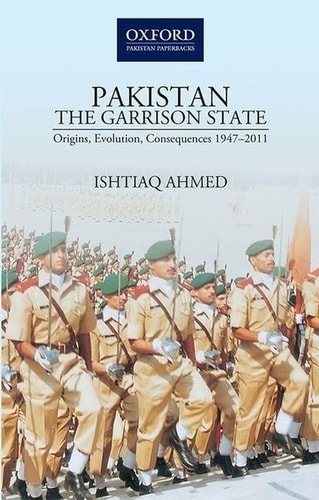
Pakistan: The Garrison State: Origins, Evolution, Consequences (1947-2011)
0
0
As an Amazon Associate and affiliate partner, Menrva Books earns from qualifying purchases. Learn more
Author Description
This study seeks to solve the following puzzle: In 1947, the Pakistan military was poorly trained and poorly armed. It also inherited highly vulnerable territory vis-à-vis the much bigger India, aggravated because of serious disputes with Afghanistan. Over the years, the military, or rather the Pakistan Army, continued to grow in power and influence, and progressively became the most powerful institution. Moreover, it became an institution with de facto veto powers at its disposal to overrule other actors within society including elected governments. Simultaneously, it began to acquire foreign patrons and donors willing to arm it as part of the Cold War competition (the United States), regional balance-of-power concerns (China), and ideological contestants for leadership over the Muslim world (Saudi Arabia, to contain Iranian influence). A perennial concern with defining the Islamic identity of Pakistan, exacerbated by the Afghan jihad, resulted in the convergence of internal and external factors to produce the fortress of Islam self-description that became current in the early twenty-first century. Over time, Pakistan succumbed to extremism and terrorism within, and was accused of being involved in similar activities within the South Asian region and beyond. Such developments have been ruinous to Pakistans economic and democratic development. This study explains how and why it happened.
Menrva's Summary
THE THESIS
This study investigates the historical trajectory that transformed the Pakistan military from a vulnerable, poorly equipped force in 1947 into the nation's dominant political institution with de facto veto power. Ishtiaq Ahmed, a political scientist, utilizes a framework of institutional analysis to examine how internal identity politics and external geopolitical alliances—specifically with the United States, China, and Saudi Arabia—facilitated this consolidation of power. The research argues that the convergence of these factors, particularly the pursuit of an Islamic identity and regional security concerns, ultimately undermined democratic development and fostered internal extremism.
THE SCOPE MAP
What You Will Find
- Historical analysis of Pakistan's military development from 1947 to 2011.
- Examination of the influence of Cold War dynamics and regional power balances on domestic policy.
- Evaluation of the impact of the 'fortress of Islam' ideological framework on state governance.
Scope Limits
- The study does not provide a comprehensive biography of individual military leaders.
- The analysis focuses primarily on institutional power dynamics rather than granular economic data sets.
THE AUTHORITY PERSPECTIVE
Scholars and regional analysts frequently cite this work as a rigorous examination of the structural factors behind Pakistan's civil-military imbalance. Experts highlight the author's ability to synthesize complex geopolitical history into a coherent argument regarding the state's institutional evolution.
Page Count:
508
Publication Date:
2020-01-01
Publisher:
Oxford University Press
ISBN-10:
0190702443
ISBN-13:
9780190702441
History
Asia history
Military History
International relations
Asian Studies
Community Tags
Similar Books