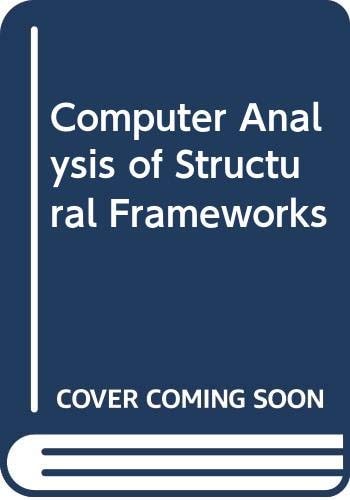
Computer Analysis of Structural Frameworks
0
0
As an Amazon Associate and affiliate partner, Menrva Books earns from qualifying purchases. Learn more
Author Description
Structural analysis is conducted during the preliminary design of civil structures, such as bridges airplanes, to ensure their feasibility. Once the outline design is complete, the structure is analyzed in detail to assess its strength and stiffness. This procedure, structural analysis, is therefore inextricably bound up with structural design. It is one of the tools that the designer uses to ensure economy and safety of the final structure. Of the many different ways in which computer technology has affected the engineering profession, it is in the field of structural analysis that the impact has been most profound. The computer's ability to handle vast amounts of arithmetic with speed and accuracy has made computationally intensive methods viable. This book offers an overview of this critical field. The authors use short computer programs to perform each of the standard procedures used in commercial structural analysis programs. The programs are written in BASIC and are designed to run on any computer from a desktop microcomputer to a mainframe machine. Each program is clear and complete in itself. Also presented are a number of structural analysis programs for a number of different framework types. This second edition illustrates the simplicity and flexibility of the stiffness method by considering problems in the field of structural dynamics. The text is designed for students and professionals in civil, mechanical, structural, and aeronautical engineering.
Menrva's Summary
THE THESIS
This text investigates the integration of computer-based computational methods into the standard procedures of structural analysis for civil, mechanical, and aeronautical engineering. The author, James A. D. Balfour, provides a technical framework for applying the stiffness method to various framework types, emphasizing the transition from preliminary design to detailed strength and stiffness assessment. By utilizing BASIC programming, the book demonstrates how computational speed and accuracy enhance the efficiency and safety of structural design processes.
THE SCOPE MAP
What You Will Find
- Implementation of standard structural analysis procedures using BASIC computer programs.
- Application of the stiffness method to diverse framework types.
- Analysis of structural dynamics problems to illustrate computational flexibility.
- Practical methodologies for transitioning from outline design to detailed structural assessment.
THE AUTHORITY PERSPECTIVE
This work serves as a technical resource for students and professionals seeking to understand the mechanics of computer-aided structural analysis. The focus on accessible, self-contained code examples suggests a practical, hands-on approach to mastering engineering computation.
Page Count:
256
Publication Date:
1986-09-25
Publisher:
HarperCollins Publishers
ISBN-10:
0003830578
ISBN-13:
9780003830576
Aeronautical Engineering
Structural analysis
Mechanical engineering
Engineering
Computer Programming
Civil Engineering
Community Tags
Similar Books