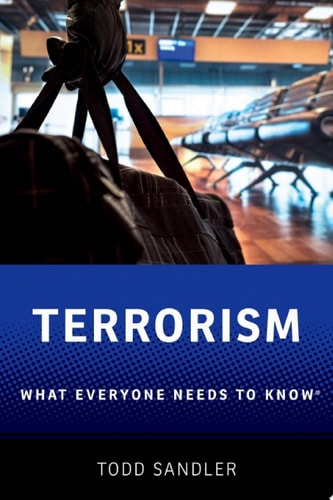
Terrorism: What Everyone Needs to Know
0
0
As an Amazon Associate and affiliate partner, Menrva Books earns from qualifying purchases. Learn more
Author Description
Terrorism is one of the driving geopolitical trends of our era. Spectacular events are recognized by their dates--for example, the 9/11 attacks in New York and Washington and the 7/7 London bombings. It was a terrorist attack that drew the United States into a war in the greater Middle East that has lasted over fifteen years. Many other attacks, including those in non-Western countries, receive far less attention even though they may be more frequent and cumulatively cause more casualties.In Terrorism: What Everyone Needs to Know®, Todd Sandler, one of America's leading scholars on the topic, provides a broad and example-rich overview of this perennially important issue. After clearly defining terrorism, he then discusses terrorism's causes, the nature of terrorist groups, how governments seek to counter terrorism, its economic consequences, and the future of terrorism. He focuses, in particular, on the extent to which specific motivations (nationalism/separatism, left and right extremism, and religious fundamentalism) and general conditions (poverty, globalization, and regime type) affect the frequency and costs of terrorism. As he explains, researchers have never established a link between poverty and terrorism or between globalization and terrorism. He also identifies many other widely-held misconceptions. Throughout, he emphasizes that terrorists are rational actors who seek political goals subject to situation-specific constraints. They respond to enhanced security measures by altering their tactics, targets, and location, making their reactions predictable. Both highly accessible and theoretically powerful, this book is the perfect primer for anyone interested in the ongoing threat of terrorism.
Menrva's Summary
THE THESIS
This book investigates the core question of how terrorism functions as a rational geopolitical phenomenon and what factors actually drive its frequency and impact. Todd Sandler, a prominent scholar in the economics of terrorism, utilizes empirical data and historical analysis to dismantle common misconceptions regarding the motivations and consequences of terrorist activity. He presents a framework that treats terrorists as rational actors operating within specific constraints, thereby providing a logical basis for understanding their tactical shifts and strategic goals.
THE SCOPE MAP
What You Will Find
- Analysis of the relationship between terrorism and variables like poverty, globalization, and regime type
- Examination of terrorist group structures and organizational dynamics
- Evaluation of government counter-terrorism strategies and their economic consequences
Scope Limits
- Does not provide a comprehensive history of every individual terrorist organization
- Does not offer specific tactical advice for personal security or intelligence operations
THE AUTHORITY PERSPECTIVE
Experts recognize this work as a foundational primer that successfully bridges academic rigor with accessibility for a general audience. Readers frequently note that the author's economic perspective provides a clear, objective lens for analyzing complex geopolitical threats.
Page Count:
210
Publication Date:
2018-01-01
Publisher:
Oxford University Press
ISBN-10:
0190845872
ISBN-13:
9780190845872
Economics
International relations
Security Studies
Community Tags
Other Editions(4)
Similar Books








Reader Comments
Share Your Thoughts
No comments yet. Be the first to share your thoughts!