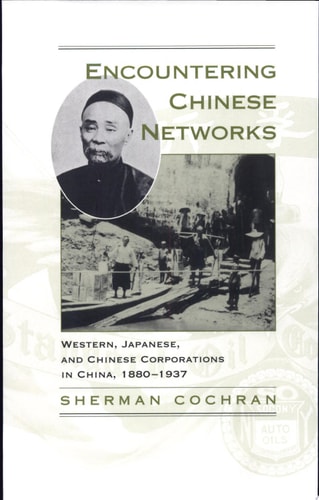
Encountering Chinese Networks: Western, Japanese, and Chinese Corporations in China, 1880-1937
0
0
As an Amazon Associate and affiliate partner, Menrva Books earns from qualifying purchases. Learn more
Author Description
Big businesses have faced a persistent dilemma in China since the nineteenth century: how to retain control over corporate hierarchies while adapting to local social networks. Sherman Cochran, in the first study to compare Western, Japanese, and Chinese businesses in Chinese history, shows how various businesses have struggled with this issue as they have adjusted to dramatic changes in Chinese society, politics, and foreign affairs. Cochran devotes a chapter each to six of the biggest business ventures in China before the Communist revolution: two Western-owned companies, Standard Oil and British-American Tobacco Company; two Japanese-owned companies, Mitsui Trading Company and Naigai Cotton Company; and two Chinese-owned firms, Shenxin Cotton Mills and China Match Company. In each case, he notes the businesses' efforts to introduce corporate hierarchies for managing the distribution of goods and the organization of factory workers, and he describes their encounters with a variety of Chinese social networks: tenacious factions of English-speaking compradors and powerful trade associations of non-English-speaking merchants channeling goods into the marketplace; and small cliques of independent labor bosses and big gangs of underworld figures controlling workers in the factories. Drawing upon archival sources and individual interviews, Cochran describes the wide range of approaches that these businesses adopted to deal with Chinese social networks. Each business negotiated its own distinctive relationship with local networks, and as each business learned about marketing goods and managing factory workers in China, it adjusted this relationship. Sometimes it strengthened its hierarchical control over networks and sometimes it delegated authority to networks, but it could not afford to take networks for granted or regard them as static because they, in turn, took their own initiative and made their own adjustments. In this book Cochran calls into
Menrva's Summary
THE THESIS
This book investigates how Western, Japanese, and Chinese corporations operating in China between 1880 and 1937 navigated the complex interplay between formal corporate hierarchies and informal local social networks. Sherman Cochran, drawing on extensive archival research and interviews, compares six major business ventures: Standard Oil and British-American Tobacco (Western); Mitsui Trading Company and Naigai Cotton Company (Japanese); and Shenxin Cotton Mills and China Match Company (Chinese). The study examines how these companies attempted to manage distribution and factory labor through hierarchical structures while simultaneously engaging with Chinese social networks, including compradors, trade associations, labor bosses, and underworld figures. Cochran details the diverse strategies employed by these businesses to adapt to and negotiate with these local networks, highlighting that each firm developed a unique relationship that evolved over time as they learned to market goods and manage workers in the dynamic Chinese environment.
THE SCOPE MAP
- Comparative analysis of Western, Japanese, and Chinese corporations in China (1880-1937).
- Case studies of six major companies: Standard Oil, British-American Tobacco, Mitsui Trading Company, Naigai Cotton Company, Shenxin Cotton Mills, and China Match Company.
- Examination of the tension between formal corporate hierarchies and informal local social networks.
- Analysis of how businesses managed distribution channels and factory labor.
- Exploration of interactions with Chinese social networks such as compradors, trade associations, labor bosses, and gangs.
- Discussion of the adaptive strategies employed by businesses to negotiate relationships with local networks.
- Use of archival sources and individual interviews as primary research methods.
- Focus on the evolving nature of business-industry relationships in response to changing social, political, and foreign affairs in China.
THE AUTHORITY PERSPECTIVE
The book is recognized for its pioneering comparative approach to understanding business operations in historical China, offering a nuanced view of how foreign and domestic firms adapted to local social structures. Scholars have noted its detailed case studies and its contribution to the fields of economic history and Chinese studies. The work is appreciated for its in-depth analysis of the challenges and strategies involved in managing corporate hierarchies within the context of China's complex social networks. It provides a valuable framework for understanding the persistent dilemmas faced by businesses operating in transitional economies.
Page Count:
257
Publication Date:
2000-01-01
Publisher:
University of California Press
ISBN-10:
0520921895
ISBN-13:
9780520921894
Non-Fiction
History
Corporate Strategy
Social Networks
Chinese History
Business History
Economic History
Community Tags
Similar Books






Reader Comments
Share Your Thoughts
No comments yet. Be the first to share your thoughts!