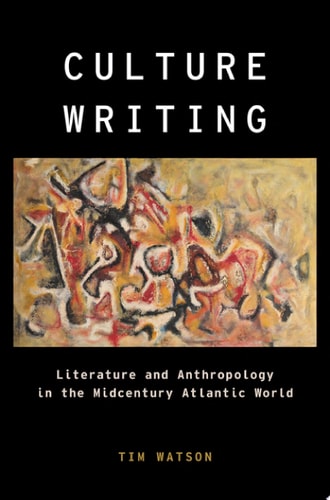
Culture Writing: Literature and Anthropology in the Midcentury Atlantic World
0
0
As an Amazon Associate and affiliate partner, Menrva Books earns from qualifying purchases. Learn more
Author Description
Focusing on the 1950s and early 1960s, Culture Writing argues that this period in Britain, the United States, France, and the Caribbean was characterized by dynamic exchanges between literary writers and anthropologists on both sides of the Atlantic. As the British and French empires collapsed and the United States rose to global power in the early Cold War, and as intellectuals from the decolonizing world challenged the cultural hegemony of the West, some anthropologists began to assess their discipline's complicity with empire and experimented with literary forms and technique. Culture Writing shows that the "literary turn" in anthropology took place earlier than has conventionally been assumed, in the 1950s rather than the 1970s and 80s. Simultaneously, some literary writers reacted to the end of the period of modernist experimentation by turning to ethnographic methods for representing the people and cultural practices of Britain, France, and the United States, bringing anthropology back home. There is analysis of literary writers who had a significant professional engagement with anthropology and brought some of its techniques and research questions into literary composition: Barbara Pym (Britain), Ursula Le Guin and Saul Bellow (United States), Édouard Glissant (Martinique), and Michel Leiris (France). On the side of ethnography, the book analyzes works by anthropologists who either explicitly or surreptitiously adopted literary forms for their writing about culture: Laura Bohannan (United States), Michel Leiris and Claude Lévi-Strauss (France), and Mary Douglas (Britain). Culture Writing concludes with an epilogue that shows how the literature-anthropology conversation continues into the postcolonial period in the work of Indian author-anthropologist Amitav Ghosh and Jamaican author-sociologist Erna Brodber.
Menrva's Summary
THE THESIS
This book investigates the historical intersection between literary production and anthropological practice during the mid-twentieth century, challenging the timeline of the so-called 'literary turn' in social science. Tim Watson, a professor of English, utilizes archival research and comparative analysis to demonstrate that the exchange between these disciplines was already robust in the 1950s and 1960s. He argues that as colonial structures dissolved and Cold War geopolitics shifted, writers and ethnographers began to borrow methodologies from one another to better represent shifting cultural identities and the decline of imperial hegemony.
THE SCOPE MAP
What You Will Find
- Analysis of the midcentury intellectual climate in Britain, France, the United States, and the Caribbean.
- Examination of literary figures including Barbara Pym, Ursula Le Guin, Saul Bellow, Édouard Glissant, and Michel Leiris.
- Evaluation of anthropological works by Laura Bohannan, Claude Lévi-Strauss, and Mary Douglas.
- Discussion of the transition from colonial ethnography to postcolonial self-reflection.
Scope Limits
- The study focuses primarily on the 1950s and early 1960s, excluding earlier modernist developments or later postmodern ethnographic trends.
- The analysis is limited to specific Atlantic-world intellectual circles and does not provide a global survey of all anthropological-literary intersections.
THE AUTHORITY PERSPECTIVE
Scholars in the fields of modernism and anthropology recognize this text as a significant revision of the history of interdisciplinary exchange. Readers frequently note the academic density of the prose, which is intended for an audience familiar with both literary theory and the history of social sciences.
Page Count:
240
Publication Date:
2018-01-01
Publisher:
Oxford University Press
ISBN-10:
0190852690
ISBN-13:
9780190852696
English & College Success
English
Anthropology
Modernism
History of Ideas
Literary Criticism
Cultural Anthropology
Community Tags
Similar Books