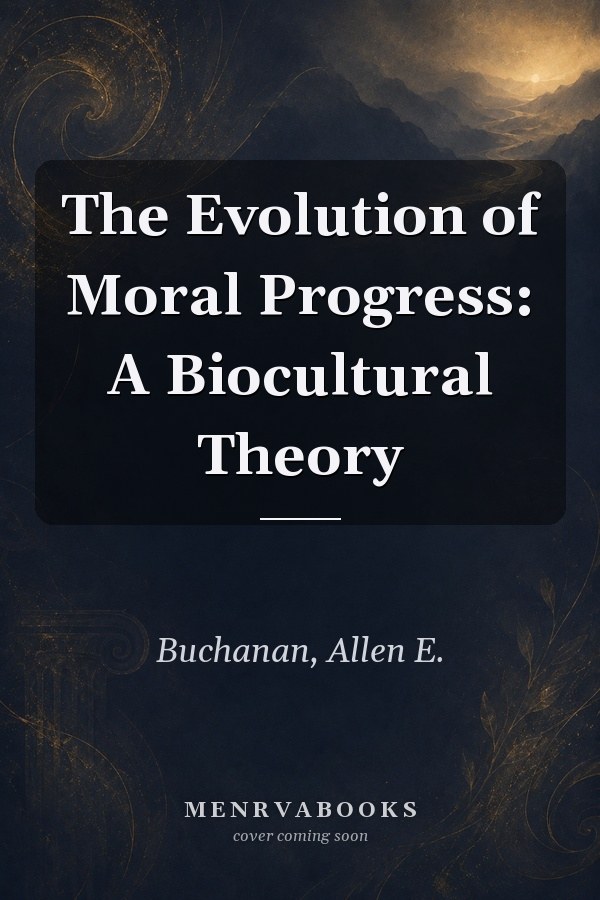
The Evolution of Moral Progress: A Biocultural Theory
0
0
As an Amazon Associate and affiliate partner, Menrva Books earns from qualifying purchases. Learn more
Author Description
Steven Pinker has said that one of the most important questions humans can ask of themselves is whether moral progress has occurred or is likely to occur. Buchanan and Powell here address that question, in order to provide the first naturalistic, empirically-informed and analytically sophisticated theory of moral progress-explaining the capacities in the human brain that allow for it, the role of the environment, and how contingent and fragile moral progress can be. Allen Buchanan and Russell Powell. Previously issued in print: 2018. Includes bibliographical references and index.
Menrva's Summary
THE THESIS
This work investigates whether moral progress is a tangible phenomenon by proposing a naturalistic, biocultural theory of how human moral capacities evolve. Allen Buchanan and Russell Powell synthesize insights from evolutionary biology, cognitive science, and moral philosophy to construct a framework that accounts for both the biological underpinnings of human morality and the environmental factors that shape it. The authors argue that moral progress is not an inevitable trajectory but a contingent and fragile process dependent on specific biocultural conditions.
THE SCOPE MAP
What You Will Find
- A biocultural framework for understanding moral development
- Analysis of the cognitive and neural capacities required for moral growth
- Examination of the role of environmental and cultural contingencies
- Discussion on the fragility and potential reversal of moral progress
Scope Limits
- Does not provide a prescriptive guide for specific modern political policies
- Does not offer a theological or purely metaphysical defense of morality
THE AUTHORITY PERSPECTIVE
Scholars and critics recognize this text as a rigorous, interdisciplinary contribution to the study of moral evolution. Readers frequently note the academic density of the prose, which requires familiarity with both philosophical argumentation and evolutionary theory.
Page Count:
0
Publication Date:
1900-01-01
Publisher:
Oxford University Press,
ISBN-10:
0190868449
ISBN-13:
9780190868444
Philosophy
Social Science
Evolutionary Biology
Ethics
Community Tags
Similar Books