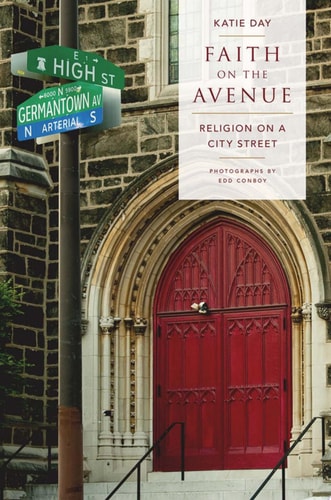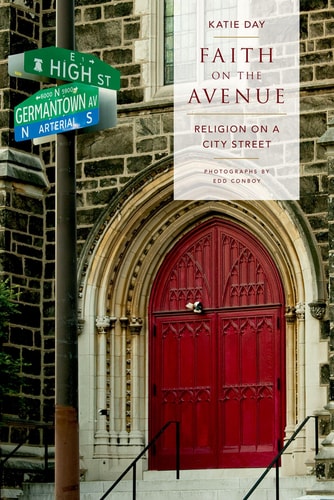
Faith on the Avenue: Religion on a City Street
0
0
As an Amazon Associate and affiliate partner, Menrva Books earns from qualifying purchases. Learn more
Author Description
In a richly illustrated, revelatory study of Philadelphia's Germantown Avenue, home to a diverse array of more than 90 Christian and Muslim congregations, Katie Day explores the formative and multifaceted role of religious congregations within an urban environment.Germantown Avenue cuts through Philadelphia for eight and a half miles, from the affluent neighborhood of Chestnut Hill through the high crime section known as "the Badlands." The congregations along this route range from the wealthiest to the poorest populations in Philadelphia. Some congregants are immigrants who find safety and support in close fellowship, while others are long-time residents whose congregations work actively to provide social services. Cities undergo constant change, and their congregations change with them. As Day observes, some congregations have sprung up in former commercial strips, harboring new arrivals and recreating a sense of home, and others form an anchor for a neighborhood across generations, providing a connection to the past and a hope of stability for the future.Drawing on years of research, in-depth interviews with religious leaders and congregants, and a wealth of demographic data, Day demonstrates the powerful influence cities exert on their congregations, and the surprising and important impact congregations have on their urban environments.
Menrva's Summary
THE THESIS
How do religious congregations function as both products and architects of the urban environment along a single, diverse city corridor? Katie Day, a professor of church and society, utilizes years of sociological research and ethnographic fieldwork to examine the symbiotic relationship between faith communities and the changing landscape of Philadelphia's Germantown Avenue. Her argument posits that congregations serve as critical anchors for social stability and identity, even as they are simultaneously reshaped by the economic and demographic pressures of the city.
THE SCOPE MAP
What You Will Find
- Demographic analysis of over 90 Christian and Muslim congregations along an eight-mile urban stretch.
- Qualitative data derived from in-depth interviews with religious leaders and local congregants.
- Examination of the role of faith-based organizations in providing social services and community support.
- Comparative study of congregations ranging from affluent neighborhoods to high-crime urban sectors.
Scope Limits
- The study is geographically confined to Germantown Avenue in Philadelphia and does not attempt to generalize findings to all global urban centers.
- The research focuses primarily on Christian and Muslim institutions, excluding other religious traditions present in the city.
THE AUTHORITY PERSPECTIVE
Scholars in urban sociology and practical theology identify this work as a significant contribution to the study of place-based religion. Readers frequently note the balance between rigorous demographic data and the personal narratives of congregants, making it a useful resource for both academic researchers and community organizers.
Page Count:
266
Publication Date:
2018-03-01
Publisher:
Oxford University Press
ISBN-10:
0190868368
ISBN-13:
9780190868369
Religion
Sociology
Community Development
United States
Social Life
Philadelphia History
Urban Studies
Councils And Synods
Cities And Towns
Community Tags
Similar Books