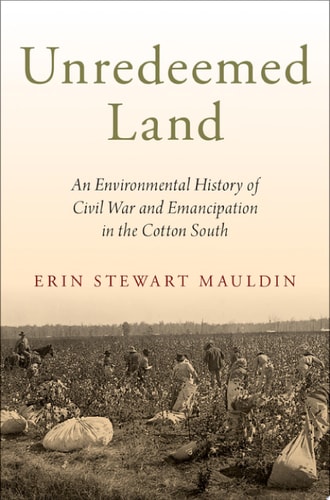
Unredeemed Land: An Environmental History of Civil War and Emancipation in the Cotton South
0
0
As an Amazon Associate and affiliate partner, Menrva Books earns from qualifying purchases. Learn more
Author Description
How did the Civil War and the emancipation of four million slaves reconfigure the natural landscape in the South and the farming economy dependent upon it? An innovative reconsideration of the Civil War's profound impact on southern history, Unredeemed Land traces the environmental constraints that shaped the rural South's transition to capitalism during the late nineteenth century. Dixie's "King Cotton" required extensive land use techniques across large swaths of acreage, fresh soil, and slave-based agriculture in order to remain profitable. But wartime destruction and the rise of the contract labor system closed off those possibilities and necessitated increasingly intensive methods of cultivation that worked against the environment. The resulting disconnect between farmers' use of the land and what the natural environment could support intensified the economic dislocation of freed people, poor farmers, and sharecroppers. Erin Stewart Mauldin demonstrates how the Civil War and emancipation accelerated ongoing ecological change in ways that hastened the postbellum collapse of the region's subsistence economy, encouraged the expansion of cotton production, and ultimately kept cotton farmers trapped in a cycle of debt and tenancy.The first environmental history to bridge the antebellum, Civil War, and Reconstruction periods, Unredeemed Land powerfully examines the ways military conflict and emancipation left enduring ecological legacies.
Menrva's Summary
THE THESIS
This book investigates how the environmental consequences of the American Civil War and the end of slavery fundamentally restructured the agricultural economy of the American South. Author Erin Stewart Mauldin, a historian specializing in the nineteenth-century South, utilizes agricultural records, land-use data, and environmental analysis to argue that the transition to postbellum capitalism was dictated by ecological constraints. She posits that the shift from slave-based labor to contract systems forced farmers into intensive cultivation methods that degraded the soil and trapped rural populations in cycles of debt.
THE SCOPE MAP
What You Will Find
- Analysis of land-use techniques in the antebellum versus postbellum South.
- Examination of the transition from subsistence farming to commercial cotton production.
- Data regarding the impact of wartime destruction on soil health and agricultural viability.
- Evaluation of how emancipation influenced labor systems and land management.
Scope Limits
- The study focuses primarily on the Cotton South and does not provide an exhaustive analysis of industrial or urban environmental impacts.
- The narrative concludes with the late nineteenth-century transition to tenancy and does not cover twentieth-century agricultural developments.
THE AUTHORITY PERSPECTIVE
Historians and environmental scholars recognize this work as a significant contribution to the field for its integration of ecological factors into the traditional narrative of Reconstruction. Readers frequently note the academic density of the prose, which provides a rigorous examination of the intersection between human labor systems and natural resource management.
Page Count:
256
Publication Date:
2018-01-01
Publisher:
Oxford University Press
ISBN-10:
0190865199
ISBN-13:
9780190865191
History
Reconstruction
Civil War
Economic History
Environmental History
United States
Agriculture
Cotton Trade
American History
Community Tags
Similar Books