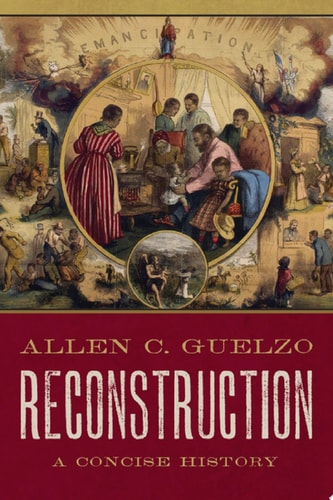
Reconstruction: A Concise History
0
0
As an Amazon Associate and affiliate partner, Menrva Books earns from qualifying purchases. Learn more
Author Description
The era known as Reconstruction is one of the unhappiest times in American history. It succeeded in reuniting the nation politically after the Civil War but in little else. Conflict shifted from the battlefield to the Capitol as Congress warred with President Andrew Johnson over just what to do with the South. Johnson's plan of Presidential Reconstruction, which was sympathetic to the former Confederacy and allowed repressive measures such as the "black codes," would ultimately lead to his impeachment and the institution of Radical Reconstruction. While Reconstruction saw the ratification of the 14th and 15th Amendments, expanding the rights and suffrage of African Americans, it largely failed to chart a progressive course for race relations after the abolition of slavery and the rise of Jim Crow. It also struggled to manage the Southern resistance towards a Northern free-labor economy. However, these failures cannot obscure a number of accomplishments with long-term consequences for American life, among them the Civil Rights Act, the election of the first African American representatives to Congress, and the avoidance of renewed civil war. Reconstruction suffered from poor leadership and uncertainty of direction, but it also laid the groundwork for renewed struggles for racial equality during the civil rights movement.In this concise history, award-winning historian Allen C. Guelzo delves into the constitutional, political, and social issues behind Reconstruction to provide a lucid and original account of a historical moment that left an indelible mark on the American social fabric.
Menrva's Summary
THE THESIS
How did the Reconstruction era succeed in politically reuniting the United States while simultaneously failing to establish a stable framework for racial equality and economic integration? Allen C. Guelzo, a historian specializing in the American Civil War and the nineteenth century, examines the constitutional and political volatility of the post-Civil War period. He argues that the era was defined by a fundamental lack of direction and poor leadership, which ultimately allowed for the rise of Jim Crow despite the passage of significant civil rights legislation. The text provides a structured analysis of the transition from Presidential to Radical Reconstruction and the subsequent impact on the American social fabric.
THE SCOPE MAP
What You Will Find
- Analysis of the conflict between Congress and President Andrew Johnson
- Examination of the 14th and 15th Amendments
- Overview of the transition to a Northern free-labor economy
- Discussion of the rise of Southern resistance and black codes
Scope Limits
- The text does not provide an exhaustive day-by-day chronicle of the era
- It focuses primarily on constitutional and political developments rather than localized social histories
THE AUTHORITY PERSPECTIVE
Historians and readers recognize this work as a highly accessible synthesis of a complex and often misunderstood period in American history. Experts frequently note that Guelzo provides a balanced perspective that acknowledges both the legislative achievements and the systemic failures of the era.
Page Count:
188
Publication Date:
2018-01-01
Publisher:
Oxford University Press
ISBN-10:
0190865717
ISBN-13:
9780190865719
History
Political History
Social History
Civil War
Reconstruction Era
American History
Community Tags
Similar Books