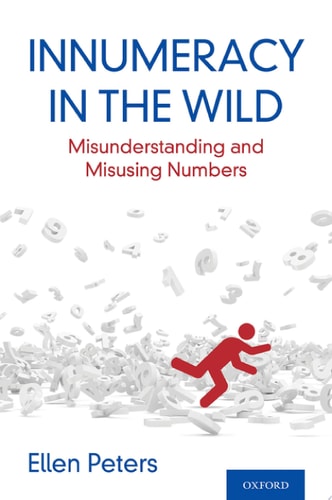
Innumeracy in the Wild: Misunderstanding and Misusing Numbers
0
0
As an Amazon Associate and affiliate partner, Menrva Books earns from qualifying purchases. Learn more
Author Description
Cover -- Innumeracy In The Wild -- Copyright -- Contents -- Preface -- Acknowledgments -- I. Introduction -- 1. The Types And Extent Of Innumeracy -- Ii. The Objectively Innumerate -- 2 Innumeracy, Incomprehension, And Inconsistency -- 3 Reliance On Heuristics And Concrete, Easy-to-evaluate Attributes -- 4 Feelings And Frames -- Iii. The Habits Of The Highly Numerate -- 5 Thinking Harder With Numbers -- 6 The Highly Numerate Understand The Feel Of Numbers -- 7. Numeric Sensitivity And Consistent Use Of Numbers -- 8 Numerically Imperfect Reasoning Among The Highly Numerate Iv. Objective Numeracy, Life Outcomes, And Research Issues And Opportunities -- 9 Numeracy's Secret Connection With Life Outcomes -- 10 Issues And Opportunities In Objective Numeracy Research -- V. The Emergence Of Number Understanding -- 11 The Approximate Number System (ans) And Discriminating Magnitudes -- 12 Genetics And Formal Education -- Vi. Two Additional Ways Of Knowing Numbers -- 13. Discriminating Numbers Allows For Better Decisions -- 14. Subjective Numeracy And Knowing What You Know -- Vii. Numbers Are Just Numbers: The Impotence Of Data Versus The Power Of Information 15. Evidence-based Information Presentation Matters -- 16. Provide Numbers But Reduce Cognitive Effort -- 17. Provide Evaluative Meaning And Direct Attention -- Viii. Becoming More Numerate -- 18. Training Numeracy -- 19. Reflections On Numeracy And The Power Of Reasoning Numerically -- Appendix -- Name Index -- Subject Index. Ellen Peters. Includes Bibliographical References And Indexes. Electronic Reproduction. Oxford Available Via World Wide Web.
Menrva's Summary
THE THESIS
How does the inability to process and interpret numerical information—innumeracy—fundamentally alter human decision-making and life outcomes? Ellen Peters, a prominent researcher in decision psychology, synthesizes decades of empirical data to explain the cognitive mechanisms behind numerical comprehension. She argues that numeracy is not merely a mathematical skill but a critical cognitive tool that shapes how individuals perceive risk, evaluate information, and navigate complex environments.
THE SCOPE MAP
What You Will Find
- Analysis of the distinction between objective and subjective numeracy.
- Examination of the Approximate Number System (ANS) and its role in human cognition.
- Evidence-based strategies for presenting data to improve public understanding.
- Case studies linking numerical literacy to health, financial, and life outcomes.
Scope Limits
- The text does not provide a comprehensive curriculum for teaching advanced mathematics.
- It does not focus on the history of mathematical notation or pure theoretical mathematics.
THE AUTHORITY PERSPECTIVE
Experts in behavioral science recognize this work as a definitive synthesis of how numerical processing influences real-world judgment. Readers frequently note the clarity of the prose, which makes complex psychological research accessible to both academic and general audiences.
Page Count:
200
Publication Date:
2020-01-01
Publisher:
Oxford University Press,
ISBN-10:
019086110X
ISBN-13:
9780190861100
Psychology
Numeracy
Education
Decision Making
Mathematics
Community Tags
Similar Books