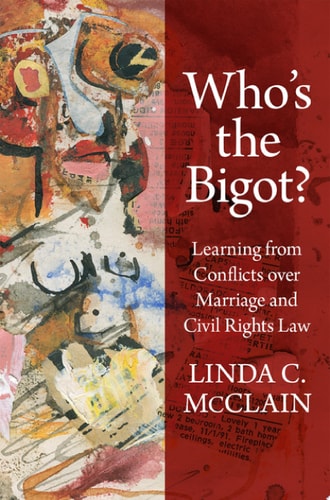
Who's the Bigot?
0
0
As an Amazon Associate and affiliate partner, Menrva Books earns from qualifying purchases. Learn more
Author Description
Historically, critics of interracial, interfaith, and most recently same-sex marriage have invoked conscience and religious liberty to defend their objections, and often they have been accused of bigotry. Although denouncing and preventing bigotry is a shared political value with a long history, people disagree over who is a bigot and what makes a belief, attitude, or action bigoted. This is evident from the rejoinder that calling out bigotry is intolerant political correctness, even bigotry itself. In Who's the Bigot?, the eminent legal scholar Linda C. McClain traces the rhetoric of bigotry and conscience across a range of debates relating to marriage and antidiscrimination law. Is bigotry simply the term society gives to repudiated beliefs that now are beyond the pale? She argues that the differing views people hold about bigotry reflect competing understandings of what it means to be on the wrong side of history and the ways present forms of discrimination resemble or differ from past forms. Furthermore, McClain shows that bigotry has both a backward- and forward-looking dimension. We not only learn the meaning of bigotry by looking to the past, but we also use examples of bigotry, on which there is now consensus, as the basis for making new judgments about what does or does not constitute bigotry and coming to new understandings of both injustice and justice. By examining charges of bigotry and defenses based on conscience and religious belief in these debates, Who's the Bigot? makes a novel and timely contribution to our understanding of the relationship between religious liberty and discrimination in American life.
Menrva's Summary
THE THESIS
This book investigates the contested definition of bigotry and its role in shaping contemporary debates over religious liberty, conscience, and antidiscrimination law. Linda C. McClain, a legal scholar, utilizes historical analysis and case law to examine how accusations of bigotry function within American political discourse. She argues that the term serves as a mechanism for defining societal boundaries, reflecting competing visions of justice and the evolving interpretation of historical progress.
THE SCOPE MAP
What You Will Find
- Analysis of legal arguments regarding interracial, interfaith, and same-sex marriage.
- Examination of the rhetoric surrounding conscience and religious liberty claims.
- Theoretical framework for understanding the backward- and forward-looking dimensions of bigotry.
Scope Limits
- The text focuses primarily on the American legal and political context.
- It does not provide a comprehensive history of global religious discrimination.
THE AUTHORITY PERSPECTIVE
Legal scholars and political analysts identify this work as a significant contribution to the study of antidiscrimination law and the intersection of faith and public policy. Readers frequently note the academic rigor and the balanced approach the author takes when navigating highly polarized social debates.
Page Count:
288
Publication Date:
2020-01-01
Publisher:
Oxford University Press
ISBN-10:
0190877219
ISBN-13:
9780190877217
Ethics
Sociology
Civil Rights
Law
Community Tags
Similar Books