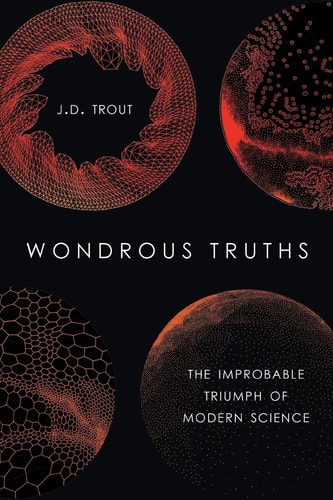
Wondrous Truths: The Improbable Triumph of Modern Science
0
0
As an Amazon Associate and affiliate partner, Menrva Books earns from qualifying purchases. Learn more
Author Description
A fresh, daring, and genuine alternative to the traditional story of scientific progressExplaining the world around us, and the life within it, is one of the most uniquely human drives, and the most celebrated activity of science. Good explanations are what provide accurate causal accounts of the things we wonder at, but explanation's earthly origins haven't grounded it: we have used it to account for the grandest and most wondrous mysteries in the natural world. Explanations give us a sense of understanding, but an explanation that feels right doesn't mean it is true. For every true explanation, there is a false one that feels just as good. A good theory's explanations, though, have a much easier path to truth. This push for good explanations elevated science from medieval alchemy to electro-chemistry, or a pre-inertial physics to the forces underlying nanoparticles. And though the attempt to explain has existed as long as we have been able to wonder, a science timeline from pre-history to the present will reveal a steep curve of theoretical discovery that explodes around 1600, primarily in the West.Ranging over neuroscience, psychology, history, and policy, Wondrous Truths answers two fundamental questions-Why did science progress in the West? And why so quickly? J.D. Trout's answers are surprising. His central idea is that Western science rose above all others because it hit upon successive theories that were approximately true through an awkward assortment of accident and luck, geography and personal idiosyncrasy. Of course, intellectual ingenuity partially accounts for this persistent drive forward. But so too does the persistence of the objects of wonder. Wondrous Truths recovers the majesty of science, and provides a startling new look at the grand sweep of its biggest ideas.
Menrva's Summary
THE THESIS
What factors drove the rapid and unique development of scientific progress in the Western world? J.D. Trout, a scholar with expertise in neuroscience and philosophy, examines the evolution of scientific inquiry from pre-history to the modern era. He argues that the Western scientific trajectory was not merely a product of intellectual superiority, but rather a result of a complex interplay between geography, historical accident, personal idiosyncrasy, and the persistent nature of the objects under investigation.
THE SCOPE MAP
What You Will Find
- A historical analysis of scientific discovery from pre-history to the present day.
- An interdisciplinary framework integrating neuroscience, psychology, history, and public policy.
- An examination of the distinction between explanations that feel intuitively correct and those that are empirically true.
Scope Limits
- The text focuses primarily on the Western development of science, offering less comparative analysis of non-Western scientific traditions.
- The book does not provide a comprehensive technical manual for specific scientific fields, focusing instead on the meta-history of scientific thought.
THE AUTHORITY PERSPECTIVE
Readers and scholars frequently note the interdisciplinary breadth of the text, which bridges the gap between cognitive science and historical analysis. Experts highlight this as a thought-provoking contribution to the philosophy of science that challenges traditional narratives regarding the inevitability of scientific advancement.
Page Count:
260
Publication Date:
2018-04-26
Publisher:
Oxford University Press
ISBN-10:
0190878657
ISBN-13:
9780190878658
Science
Psychology
Non-Fiction
Neuroscience
Science History
Philosophy of
Science
Community Tags
Other Editions(2)

Similar Books













Reader Comments
Share Your Thoughts
No comments yet. Be the first to share your thoughts!