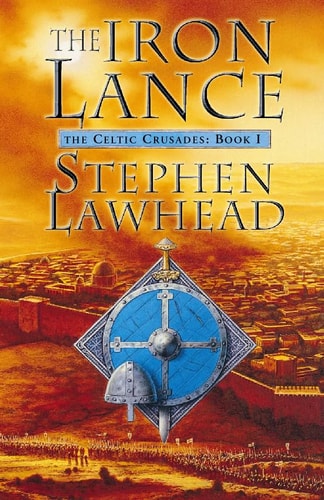
The Iron Lance
0
0
As an Amazon Associate and affiliate partner, Menrva Books earns from qualifying purchases. Learn more
Author Description
Stephen Lawhead is best known for his "Pendragon Cycle" of Arthurian fantasies. His previous novel Byzantium moved him into historical rather than mythological fiction; The Iron Lance confirms this change. It is the story of the First Crusade told by a youth from the Orkneys, a group of islands off the north coast of Scotland.At 14 Murdo Ranulfson is too young to go on a crusade. But when he and his mother are thrown off their own land by soldiers of Prince Sigurd of Norway, who has claimed the Orkneys, Murdo travels to the Holy Land to fetch back his father and brothers to reclaim their land. He witnesses at first hand the horrors of the Crusade, particularly what Lawhead calls "the rape of Jerusalem".In common with Lawhead's earlier works there is a strong Christian element to the story, but here the emphasis is on the spirituality of the Celtic monks Célé Dé contrasting with the venality of the Catholic Church of the time. The main story is framed in the late-19th century narrative of a secret religious order descended from the monks, and from Murdo. This is a powerful and well-told story. Lawhead brilliantly captures better than most American writers what feels like the true essence of medieval Britain and Europe. --David V. Barrett
Menrva's Summary
THE PULSE
After his family is displaced from their ancestral lands in the Orkneys, young Murdo Ranulfson embarks on a perilous quest to the Holy Land to retrieve his father and brothers. Driven by the necessity of reclaiming his home, Murdo navigates the brutal realities of the First Crusade, facing both the physical dangers of warfare and the complex political machinations of the era. The narrative employs a dual-timeline structure, alternating between Murdo’s harrowing experiences in the 11th century and a framing device set in the late 19th century involving a secret religious order. This framework highlights the contrast between the spiritual traditions of the Célé Dé monks and the institutional corruption of the medieval Catholic Church.
INSIDE THE PAGES
- Dual-timeline narrative structure connecting the 11th and 19th centuries
- Exploration of the Célé Dé Celtic monastic tradition
- Detailed depiction of the First Crusade and the siege of Jerusalem
- Focus on the cultural clash between Norse, Celtic, and Crusader societies
- Themes of faith, displacement, and ancestral duty
- First-person perspective providing an intimate view of historical events
- Contrast between individual spirituality and institutional religious power
- Vivid sensory descriptions of medieval European and Levantine landscapes
THE COLLECTIVE ECHO
This work is regarded as a significant transition for the author from mythological fantasy into grounded historical fiction. Critics often highlight the author's ability to capture the atmosphere of medieval Europe with a level of detail that distinguishes his prose from many contemporaries. The inclusion of the Célé Dé spiritual perspective provides a unique thematic layer that separates the narrative from standard accounts of the Crusades. Readers generally appreciate the balance between the visceral depiction of historical conflict and the introspective nature of the protagonist's personal quest.
Page Count:
581
Publication Date:
1999-01-01
Publisher:
Circles Intl
ISBN-10:
0006483216
ISBN-13:
9780006483212
Fantasy
Historical Fiction
Adventure
Historical adventure
Crusades
Medieval
Celtic
Community Tags
Similar Books