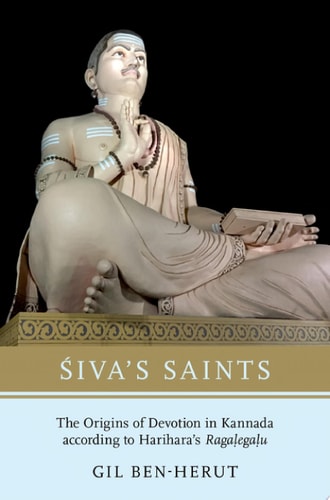
Siva's Saints
0
0
As an Amazon Associate and affiliate partner, Menrva Books earns from qualifying purchases. Learn more
Author Description
Comprising More Than Twelve Million People And Renowned For Their Resistance To Brahminical Values, The Virasaivas Are A Vibrant And Unorthodox Religious Community With A Provocative Socio-political Voice. The Virasaiva Tradition Has Produced A Vast And Original Body Of Literature, Composed Mostly In Kannada, A Dravidian Language From South India. Siva's Saints Introduces A Previously Unexplored And Central Primary Work Produced In The Early Thirteenth Century, The Ragalegalu. This Was The First Narrative Text Written About The Incipient Devotional Tradition Dedicated To The God Siva In The Kannada-speaking Regions; Through Stories Of The Saints, It Images The Life Of This New Religious Community. The Ragalegalu Inaugurated A New Era In The Production Of Devotional Narratives Accessible To Wide Audiences. Gil Ben-herut Challenges Common Notions About This Tradition In Its Nascent Phases. By Closely Reading The Saints' Stories In This Text, Siva's Saints Takes A More Nuanced Historical View Than Commonly-held Notions About The Egalitarian And Iconoclastic Nature Of The Early Tradition, Arguing Instead That Early Bhakti (devotionalism) In The Kannada-speaking Region Was Less-radical And More Accommodating Toward Traditional Religious, Social, And Political Institutions Than Thought Of Today. In Contrast To The Narrowly Sectarian And Exclusionary Vision That Shapes Later Accounts, The Ragalegalu Is Characterized By An Opposite Impulse Of Offering An Open Invitation To People From All Walks Of Life, And Their Stories Illustrate The Richness Of Their Devotional Lives. Analysis Of This Seminal Text Yields Important Insights Into The Role Of Literary Representation Of The Social And Political Development Of A Religious Community In A Pre-modern And Non-western Milieu.
Menrva's Summary
THE THESIS
This book investigates the historical origins and social character of the early Virasaiva religious community through an analysis of the thirteenth-century text, the Ragalegalu. Gil Ben-Herut, a scholar of South Asian religions, utilizes close readings of these foundational hagiographies to challenge the prevailing academic narrative that early Kannada Bhakti was inherently radical or iconoclastic. He argues that the movement was, in its nascent stages, more accommodating of existing social and political hierarchies than later sectarian accounts suggest.
THE SCOPE MAP
What You Will Find
- A detailed examination of the Ragalegalu as a primary source for early Virasaiva history.
- An analysis of the literary representation of saints within the context of pre-modern South India.
- A critical reassessment of the egalitarian claims associated with the early Bhakti movement.
Scope Limits
- The study focuses primarily on the early thirteenth-century Ragalegalu rather than the entire breadth of later Virasaiva literature.
- The analysis is restricted to the Kannada-speaking regions of South India.
THE AUTHORITY PERSPECTIVE
Scholars in the field of South Asian religious studies recognize this work as a significant contribution to the understanding of pre-modern devotional communities. Experts highlight the author's ability to synthesize literary analysis with historical inquiry to provide a more nuanced view of the Virasaiva tradition.
Page Count:
320
Publication Date:
2018-01-01
Publisher:
Oxford University Press
ISBN-10:
0190878851
ISBN-13:
9780190878856
History
Religion
Hinduism
Kannada
Asian Studies
Bhakti
Sociology of Religion
Community Tags
Similar Books