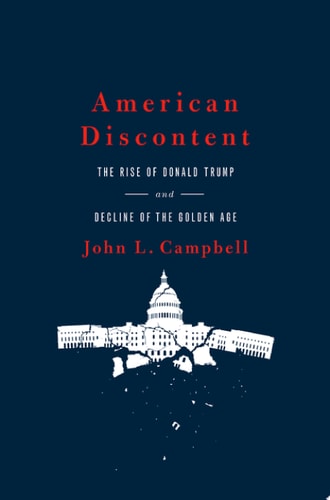
American Discontent: The Rise of Donald Trump and Decline of the Golden Age
0
0
As an Amazon Associate and affiliate partner, Menrva Books earns from qualifying purchases. Learn more
Author Description
The 2016 presidential election was unlike any other in recent memory, and Donald Trump was an entirely different kind of candidate than voters were used to seeing. He was the first true outsider to win the White House in over a century and the wealthiest populist in American history. Democrats and Republicans alike were left scratching their heads-how did this happen?In American Discontent, John L. Campbell contextualizes Donald Trump's success by focusing on the long-developing economic, racial, ideological, and political shifts that enabled Trump to win the White House. Campbell argues that Trump's rise to power was the culmination of a half-century of deep, slow-moving change in America, beginning with the decline of the Golden Age of prosperity that followed the Second World War. The worsening economic anxieties of many Americans reached a tipping point when the 2008 financial crisis and Barack Obama's election, as the first African American president, finally precipitated the worst political gridlock in generations. Americans were fed up and Trump rode a wave of discontent all the way to the White House.Campbell emphasizes the deep structural and historical factors that enabled Trump's rise to power. Since the 1970s and particularly since the mid-1990s, conflicts over how to restore American economic prosperity, how to cope with immigration and racial issues, and the failings of neoliberalism have been gradually dividing liberals from conservatives, whites from minorities, and Republicans from Democrats. Because of the general ideological polarization of politics, voters were increasingly inclined to believe alternative facts and fake news.Grounded in the underlying economic and political changes in America that stretch back decades, American Discontent provides a short, accessible, and nonpartisan explanation of Trump's rise to power.
Menrva's Summary
THE THESIS
This book investigates the structural economic, racial, and ideological shifts that facilitated the rise of Donald Trump and the subsequent decline of the post-WWII American Golden Age. John L. Campbell, a sociologist and political economist, utilizes historical data and political analysis to argue that Trump's 2016 victory was not an anomaly but the culmination of decades of systemic instability. He posits that the erosion of economic prosperity, combined with increasing racial tensions and political polarization, created a environment where populist rhetoric could successfully challenge established institutional norms.
THE SCOPE MAP
What You Will Find
- Analysis of the economic decline following the post-WWII Golden Age
- Examination of the 2008 financial crisis as a catalyst for political gridlock
- Discussion on the impact of neoliberal policy failures on the American electorate
- Evaluation of the role of alternative facts and media polarization in modern politics
Scope Limits
- Does not provide a comprehensive biography of Donald Trump
- Does not focus on the specific tactical details of the 2016 campaign trail
THE AUTHORITY PERSPECTIVE
Experts and political commentators recognize this work as a concise, nonpartisan synthesis of the structural factors that shaped modern American political discontent. Readers frequently note that the prose is accessible to a general audience while maintaining the analytical rigor expected of a sociological study.
Page Count:
240
Publication Date:
2018-06-01
Publisher:
Oxford University Press
ISBN-10:
0190872438
ISBN-13:
9780190872434
21st Century
American History
Social change
Sociology
Community Tags
Similar Books