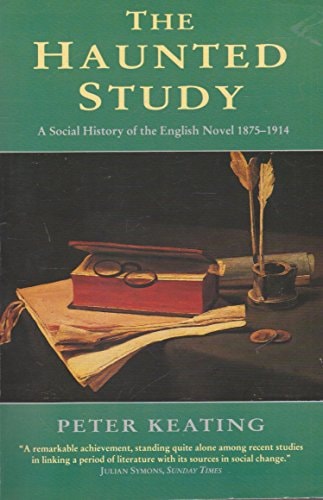
The Haunted Study: A Social History of the English Novel 1875-1914
0
0
As an Amazon Associate and affiliate partner, Menrva Books earns from qualifying purchases. Learn more
Author Description
The Haunted Study, a rare example of a work of literary history that is genuinely interdisciplinary, explores how the leading novelists of the late Victorian and Edwardian periods came to develop so many of the attitudes that are now generally accepted as characteristically modern.The writing of fiction is not treated as though it exists in some kind of isolation, but is shown to be intimately related to other forms of social activity. Conrad, James, Meredith, and their immediate modernist successors Joyce, Lawrence, and Woolf, may now seem to be set apart in a variety of crucial ways from, say, Ouida and Marie Corelli, or even Gissing, Wells, and Bennett, but all of them worked within the same rapidly changing society and were unavoidably influenced by its dominant economic, political, and cultural concerns. These influences were not peripheral, but central and formative. They profoundly affected the creation of a commercially fragmented culture as well as the nature of fiction within that culture.The Haunted Study covers an exceptionally large number of authors, from the critically despised to the critically admired, and examines the impact on their work of such factors as the professionalisation of literature, the earning power of authors, the emergence of new kinds of readers, and, disturbingly present throughout the whole period, fundamental democratic change.
Menrva's Summary
THE THESIS
This work investigates how the rapid socio-economic and political transformations of late Victorian and Edwardian England fundamentally shaped the development of the modern English novel. Peter Keating, a scholar of literary history, rejects the notion of fiction as an isolated art form, instead situating the creative output of authors like Conrad, Woolf, and Wells within the broader context of a changing commercial culture. By analyzing the professionalization of the writing trade and the shifting demographics of the reading public, Keating demonstrates that the concerns of the era were central and formative to the evolution of literary modernism.
THE SCOPE MAP
What You Will Find
- A comprehensive analysis of the literary landscape from 1875 to 1914.
- Examination of the economic pressures and professionalization affecting authors of the period.
- Comparative studies between critically acclaimed modernists and popular commercial writers like Marie Corelli.
- Exploration of how democratic change and new reader demographics influenced narrative form.
THE AUTHORITY PERSPECTIVE
The text provides a dense, interdisciplinary examination of the intersection between social history and literary production during a pivotal era of cultural transition. Its broad scope and focus on the material conditions of authorship make it a valuable resource for understanding the structural foundations of the modern novel.
Page Count:
544
Publication Date:
1991-01-01
Publisher:
Grange Books
ISBN-10:
0006862136
ISBN-13:
9780006862130
History
English
Literary Criticism
Victorian
20th Century
19th Century
Social History
c 1800 to c 1900
Edwardian Literature
British literature
Community Tags
Similar Books