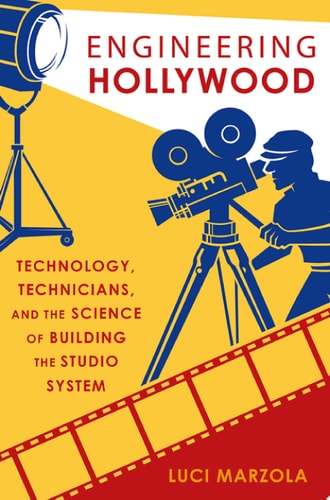
Engineering Hollywood: Technology, Technicians, and the Science of Building the Studio System
0
0
As an Amazon Associate and affiliate partner, Menrva Books earns from qualifying purchases. Learn more
Author Description
Engineering Hollywood tells the story of the formation of the Hollywood studio system not as the product of a genius producer, but as an industry that brought together creative practices and myriad cutting-edge technologies in ways that had never been seen before. Using extensive archival research, this book examines the role of technicians, engineers, and trade organizations in creating a stable technological infrastructure on which the studio system rested for decades. Here, the studio system is seen as a technology-dependent business with connections to the larger American industrial world. By focusing on the role played by technology, we see a new map of the studio system beyond the backlots of Los Angeles and the front offices in New York. In this study, Hollywood includes the labs of industrial manufacturers, the sales routes of independent firms, the garages of tinkerers, and the clubhouses of technicians' societies. Rather than focusing on the technical improvements in any particular motion picture tool, this book centers on the larger systems and infrastructures for dealing with technology in this creative industry. Engineering Hollywood argues that the American industry was stabilized and able to dominate the motion picture field for decades through collaboration over technologies of everyday use. Hollywood's relationship to its essential technology was fundamentally one of interdependence and cooperation-with manufacturers, trade organizations, and the competing studios. As such, Hollywood could be defined as an industry by participation in a closed system of cooperation that allowed a select group of producers and manufacturers to dominate the motion picture business for decades.
Menrva's Summary
THE THESIS
This book investigates how the Hollywood studio system emerged not from individual creative genius, but from the collaborative integration of industrial technology and standardized technical practices. Luci Marzola, a scholar of film history and technology, utilizes extensive archival research to argue that the stability of the studio system relied on a complex, interdependent network of engineers, trade organizations, and industrial manufacturers. By shifting the focus from individual films to the infrastructure of production, the author demonstrates how a closed system of technological cooperation allowed a select group of producers to dominate the motion picture industry for decades.
THE SCOPE MAP
What You Will Find
- Analysis of the role of trade organizations and technical societies in standardizing film production.
- Examination of the relationship between Hollywood studios and industrial manufacturers.
- Historical overview of the transition from individual tinkering to institutionalized technological infrastructure.
Scope Limits
- The text does not focus on the technical specifications or improvements of individual motion picture cameras or editing tools.
- The analysis is limited to the structural and industrial systems rather than the aesthetic evolution of film content.
THE AUTHORITY PERSPECTIVE
Scholars and film historians frequently cite this work for its rigorous archival approach to the often-overlooked industrial foundations of the studio era. Experts highlight the text as a significant contribution to media studies that successfully bridges the gap between film history and the history of technology.
Page Count:
272
Publication Date:
2021-01-01
Publisher:
Oxford University Press
ISBN-10:
0190885610
ISBN-13:
9780190885618
Industrial history
Business History
Film History
Media Studies
Humanities
Individual Director
Technology
Motion pictures
Community Tags
Similar Books