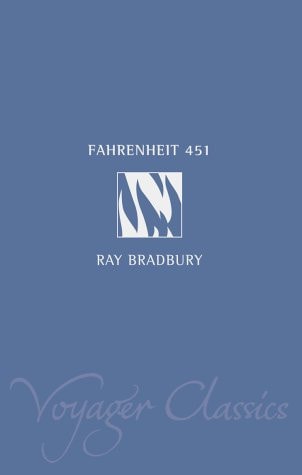
Fahrenheit 451
0
0
As an Amazon Associate and affiliate partner, Menrva Books earns from qualifying purchases. Learn more
Author Description
Guy Montag is a fireman. In his world, where television rules and literature is on the brink of extinction, firemen start fires rather than put them out. His job is to destroy the most illegal of commodities, the printed book, along with the houses in which they are hidden. Montag never questions the destruction and ruin his actions produce, returning each day to his bland life and his wife, Mildred, who spends all day with her television 'family.' But then he meets an eccentric young neighbor, Clarisse, who introduces him to a past where people didn't live in fear and to a present where one sees the world instead of merely processing it. Montag's question-filled journey begins to threaten everything he has ever known.
Menrva's Summary
THE PULSE
In a future society where books are outlawed and firemen burn them to suppress dissent, Guy Montag begins to question his role as an agent of state-mandated ignorance. Montag, a fireman who has spent his career incinerating literature, finds his worldview fractured after a series of encounters with a free-thinking neighbor and the tragic disappearance of his wife into a haze of mindless media consumption. He must navigate a landscape of high-speed surveillance and pervasive propaganda while attempting to preserve the remnants of human knowledge. The narrative follows his internal transformation from a compliant enforcer to a fugitive seeking a community of underground intellectuals who memorize texts to save them from oblivion.
INSIDE THE PAGES
- Third-person limited perspective focusing on Montag's psychological shift
- Use of sensory-rich, metaphorical prose to describe the mechanical nature of the city
- Exploration of the tension between technological convenience and intellectual stagnation
- Symbolism centered on fire as both a destructive force and a potential source of warmth
- Pacing that accelerates from a slow, atmospheric introduction to a high-stakes chase
- Dialogue-heavy scenes that highlight the disconnect between the protagonist and his peers
- A world-building focus on the 'parlor walls' as a tool for mass distraction
- Themes of censorship, memory, and the fragility of cultural history
THE COLLECTIVE ECHO
This work is widely regarded as a foundational text in dystopian literature, frequently analyzed for its prescient commentary on the influence of mass media and the erosion of critical thought. Readers and critics often highlight the stark contrast between the sterile, high-speed society Bradbury depicts and the quiet, reflective nature of the book's resistance. The prose is noted for its poetic intensity, which elevates the narrative beyond simple social critique into a meditation on the value of human consciousness. The book remains a staple in academic curricula, where it continues to spark discussions regarding the ethics of censorship and the responsibility of the individual in a conformist culture.
Page Count:
176
Publication Date:
1953-10-19
Publisher:
Voyager
ISBN-10:
0007117108
ISBN-13:
9780007117109
Fantasy
Dystopian
Science Fiction
Literature & Fiction
classic
Classics
Science Fiction
Social Commentary
Political fiction