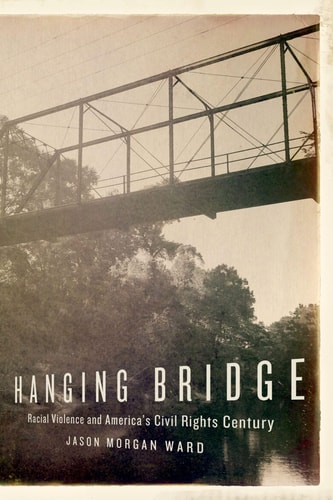
Hanging Bridge: Racial Violence and America's Civil Rights Century
0
0
As an Amazon Associate and affiliate partner, Menrva Books earns from qualifying purchases. Learn more
Author Description
Lying just south of Neshoba County, where three civil rights workers were murdered during Freedom Summer, Clarke County lay squarely in Mississippi's ― and America's ― meanest corner. Even at the height of the Civil Rights Movement in the 1960s, when the clarion call for equality and justice echoed around the country, few volunteers ventured there. Fewer still remained. Local African Americans knew why the movement had taken so long to reach them. Some spoke of a bottomless pit in the snaking Chickasawhay River in the town of Shubuta, into which white aggressors dumped bodies. Others pointed to an old steel-framed bridge across that same muddy creek.Spanning three generations, Hanging Bridge reconstructs two wartime lynchings ― the 1918 killing of two young men and two pregnant women, and the 1942 slaying of two adolescent boys ― that propped up Mississippi's white supremacist regime and hastened its demise. These organized murders reverberated well into the 1960s, when local civil rights activists again faced off against racial terrorism and more refined forms of repression.Connecting the lynchings at Hanging Bridge to each other and then to Civil Rights-era struggles over segregation, voting, poverty, Black Power, and Vietnam, Jason Morgan Ward's haunting book traces the legacy of violence that reflects the American experience of race, from the depths of Jim Crow to the emergence of a national campaign for racial equality. In the process, it creates a narrative that links living memory and meticulous research, illuminating one of the darkest places in American history and revealing the resiliency of the human spirit.
Menrva's Summary
THE THESIS
This work investigates how specific acts of racial violence in Clarke County, Mississippi, functioned as foundational pillars for the white supremacist regime and influenced the trajectory of the broader Civil Rights Movement. Jason Morgan Ward, a historian specializing in the American South, utilizes local oral histories and archival records to connect the lynchings of 1918 and 1942 to the subsequent political struggles of the 1960s. The book argues that these localized acts of terror were not isolated incidents but were integral to the maintenance of power structures that persisted well into the late twentieth century.
THE SCOPE MAP
What You Will Find
- Detailed reconstruction of the 1918 and 1942 lynchings in Shubuta, Mississippi.
- Analysis of the transition from overt racial terrorism to systemic repression during the Civil Rights era.
- Examination of the intersection between local racial violence and national movements regarding voting rights, poverty, and the Vietnam War.
Scope Limits
- The narrative is geographically centered on Clarke County, Mississippi, rather than providing a comprehensive national history of the Civil Rights Movement.
- The text focuses primarily on the legacy of specific lynchings rather than a broad biographical account of individual activists.
THE AUTHORITY PERSPECTIVE
Historians and scholars of the American South recognize this text for its meticulous archival research and its ability to bridge the gap between local memory and national historical narratives. Readers frequently note the somber, analytical tone of the prose, which effectively contextualizes individual tragedies within the broader framework of American racial history.
Page Count:
344
Publication Date:
2018-09-01
Publisher:
Oxford University Press
ISBN-10:
0190905840
ISBN-13:
9780190905842
History
True Crime
United States
Racism
African American
Civil Rights
African Americans
American History
History of the Americas
Social History
Lynching
Community Tags
Similar Books