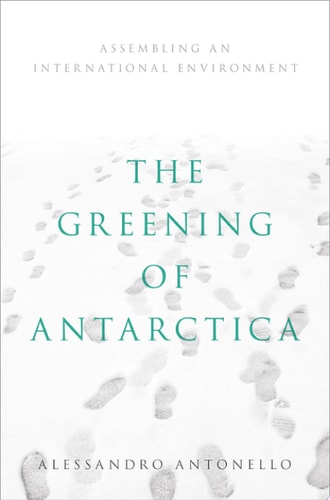
The Greening of Antarctica: Assembling an International Environment
0
0
As an Amazon Associate and affiliate partner, Menrva Books earns from qualifying purchases. Learn more
Author Description
In The Greening of Antarctica Alessandro Antonello investigates the development of an international regime of environmental protection and management between the signing of the Antarctic Treaty in 1959 and the signing of the Convention on the Conservation of Antarctic Marine Living Resources in 1980. In those two decades, the Antarctic Treaty parties and an international community of scientists reimagined what many considered a cold, sterile, and abiotic wilderness as a fragile and extensive regional ecosystem. Antonello investigates this change by analyzing the negotiations and developments surrounding four environmental agreements: the Agreed Measures for the Conservation of Antarctic Fauna and Flora in 1964; the Convention for the Conservation of Antarctic Seals in 1972; a voluntary restraint resolution on Antarctic mining in 1977; and the Convention on the Conservation of Antarctic Marine Living Resources in 1980. Though distant from world populations, Antarctica has long been a site of inter-state contest for geopolitical power and standing. This book reveals how a range of contests, geopolitical, epistemic and imaginative, created the environmental protection regime of the Antarctic Treaty System, and discusses the tension between states' individual searches for power and the collective desire for stability in the region. In this international and diplomatic context, the actors were not only trying to keep relations between themselves orderly, but they were also using treaties to order the human relationship with the environment. Drawing on a wide range of international archives, many newly-opened, The Greening of Antarctica offers the first detailed narrative of a crucial period in Antarctic history and reveals the contours of global environmental thought and diplomacy in the transformative Age of Ecology.
Menrva's Summary
THE THESIS
How did the Antarctic Treaty System evolve from a geopolitical framework into a mechanism for environmental governance between 1959 and 1980? Alessandro Antonello, a historian specializing in the environmental history of the polar regions, utilizes newly accessible international archives to trace the transformation of Antarctica from a perceived abiotic wilderness into a fragile, protected ecosystem. The book argues that the development of environmental policy in the region was inextricably linked to the competing interests of state power, scientific authority, and the emerging global consciousness of the Age of Ecology.
THE SCOPE MAP
What You Will Find
- Analysis of the Agreed Measures for the Conservation of Antarctic Fauna and Flora (1964)
- Examination of the Convention for the Conservation of Antarctic Seals (1972)
- Review of the 1977 voluntary restraint resolution on mining
- Study of the Convention on the Conservation of Antarctic Marine Living Resources (1980)
- Historical synthesis of Cold War-era international diplomacy
Scope Limits
- The text focuses primarily on the period between 1959 and 1980.
- It does not provide an exhaustive ecological survey of Antarctic flora and fauna.
THE AUTHORITY PERSPECTIVE
Scholars and historians recognize this work as a definitive account of the institutionalization of Antarctic environmental protection. Readers frequently note the meticulous use of archival evidence to bridge the gap between geopolitical strategy and environmental policy.
Page Count:
262
Publication Date:
2019-01-01
Publisher:
Oxford University Press
ISBN-10:
0190907193
ISBN-13:
9780190907198
History
Diplomacy
International relations
Special Topics
Antarctica
Community Tags
Similar Books