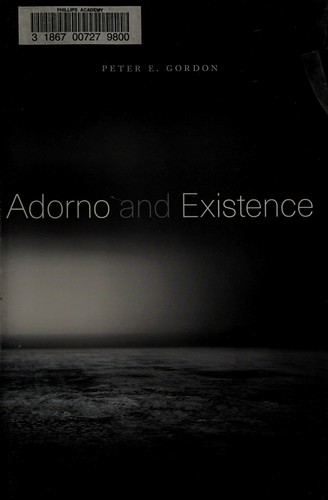
Adorno and Existence
0
0
As an Amazon Associate and affiliate partner, Menrva Books earns from qualifying purchases. Learn more
Author Description
From the beginning to the end of his career, the critical theorist and Frankfurt School philosopher Theodor W. Adorno sustained an uneasy but enduring bond with existentialism. His attitude overall was that of unsparing criticism, often verging on polemic. In Kierkegaard he saw an early paragon for the late flowering of bourgeois solipsism; in Heidegger an impresario for a "jargon of authenticity" that cloaked its idealism in an aura of pseudo-concreteness and neo-romantic kitsch; even in the more rationalist tradition of Husserl's phenomenology he detected a vain attempt of the bourgeois spirit to break free from the prison-house of immanent consciousness. Yet his enduring fascination with the philosophical canons of existentialism and phenomenology suggests a connection far more complicated and productive than mere antipathy. From his first published book on Kierkegaard's aesthetic to the mature studies in negative dialectics, Adorno was forever returning to the philosophies of bourgeois interiority, seeking the paradoxical relation between their manifest failure and their hidden promise. Scholars of critical theory often regard these philosophical adventures as unfortunate lapses into reductive sociology or as marginal to Adorno's path of intellectual development. In Adorno and Existence, Peter E. Gordon challenges this assumption, showing how the confrontation with existentialism helps us toward a deeper understanding of Adorno's own intellectual commitments. In lucid prose and with a dialectical sensitivity for the links between philosophy and life, Adorno and Existence casts new and unfamiliar light on this neglected chapter in the history of Continental philosophy.-- Includes primary source materials.
Menrva's Summary
THE THESIS
Theodor W. Adorno maintained a complex and critical relationship with existentialism and phenomenology throughout his career. Peter E. Gordon's work challenges the common scholarly view that Adorno's engagement with these philosophies was a mere distraction or a lapse into reductive sociology. Instead, Gordon argues that Adorno's persistent confrontation with existentialist thought, from his early work on Kierkegaard to his later negative dialectics, is crucial for a deeper understanding of Adorno's own intellectual commitments and philosophical project. The book illuminates the paradoxical connection between the perceived failures of bourgeois interiority and its latent potential, offering a new perspective on a neglected aspect of Continental philosophy.
THE SCOPE MAP
- Analysis of Theodor W. Adorno's critical engagement with existentialism and phenomenology.
- Exploration of Adorno's views on Kierkegaard, Heidegger, and Husserl.
- Examination of Adorno's early work on Kierkegaard's aesthetics.
- Discussion of Adorno's mature studies in negative dialectics.
- Argument that Adorno's engagement with existentialism is central to his intellectual development.
- Inclusion of primary source materials.
- Lucid prose and dialectical sensitivity in exploring the links between philosophy and life.
THE AUTHORITY PERSPECTIVE
The book is presented as a significant re-evaluation of a neglected aspect of Theodor W. Adorno's thought, challenging prevailing scholarly interpretations. By focusing on Adorno's persistent engagement with existentialism and phenomenology, Peter E. Gordon aims to shed new light on the philosopher's core intellectual commitments. The work is characterized by its lucid prose and its dialectical approach to understanding the relationship between philosophical ideas and lived experience. It promises to offer an unfamiliar perspective on a key chapter in the history of Continental philosophy.
Page Count:
256
Publication Date:
2016-01-01
ISBN-10:
0674734785
ISBN-13:
9780674734784
Philosophy
Non-Fiction
Critical Theory
Continental Philosophy
Existentialism
Community Tags
Similar Books