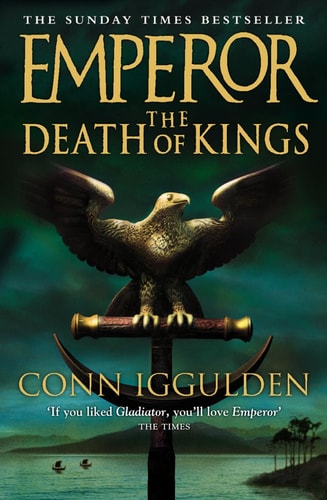
Emperor: The Death of Kings
0
0
As an Amazon Associate and affiliate partner, Menrva Books earns from qualifying purchases. Learn more
Author Description
The first book in Conn Iggulden's highly impressive Emperor series, The Gates of Rome, marked the author out as one of the most accomplished practitioners of the sweeping historical novel.The second book,, creates another panoply of the Ancient World with the young Caesar serving onboard a war galley in the dangerous tempest-tossed waters of the Mediterranean. Achieving a striking victory with his already fully formed intellect and forceful personality, things suddenly turn disastrous for him when he is captured by pirates and imprisoned on the North Coast of Africa. But Caesar knows he is not fated to end his prospects here, and uses his charisma and leadership abilities to forge a lean and lethal squadron of warriors who break out of captivity and find themselves involved in a bloody uprising in Greece. And, inevitably, Caeser is soon back on his way to Rome for another encounter that will have tremendous consequences both for him and his fellow Romans. Iggulden's skills are many and he is well aware that narratives such as this must have an irresistible forward impetus, and that's maintained with an inexorable control here. And he knows that the reader must constantly have the details of these fabulous ancient times conjured afresh throughout the book--but never at the expense of the trajectory of the story.The author's key achievement, though, is in his laser-sharp characterisation of Caesar and those he encounters--and this is where the real splendour of The Death of Kings Caesar is very much a man of his time, but the conjuring trick of allowing the modern reader to enter his psychology is always handled with quiet assurance.
Menrva's Summary
THE PULSE
After escaping a harrowing captivity at the hands of pirates, a young Julius Caesar must navigate the treacherous political and military landscapes of the Mediterranean to secure his future in Rome. Caesar relies on his burgeoning intellect and natural charisma to transform a group of fellow captives into a disciplined fighting force. His objective remains the reclamation of his status and influence, but he faces opposition from both ruthless enemies and the volatile nature of Roman power dynamics. The narrative follows his ascent through a series of high-stakes encounters, maintaining a focus on his strategic development and the physical challenges of the ancient world.
INSIDE THE PAGES
- Detailed depictions of naval warfare and Mediterranean maritime conditions
- Exploration of the psychological development of a young Julius Caesar
- Focus on the transition from captive to military leader
- Integration of historical figures and political intrigue within the Roman Republic
- Pacing driven by the protagonist's rapid rise and tactical decision-making
- Vivid descriptions of the North African and Greek landscapes
- Emphasis on the formation of personal loyalty and military discipline
- Third-person narrative perspective that balances action with character introspection
THE COLLECTIVE ECHO
This work is characterized by its focus on the early, formative years of Julius Caesar, emphasizing his transition from a young man of potential to a formidable leader. The narrative structure prioritizes forward momentum, ensuring that the historical setting serves the trajectory of the protagonist's life rather than overshadowing it. Readers often note the author's ability to ground the larger-than-life figure of Caesar in a human, relatable psychology that feels accessible to modern audiences. The prose maintains a consistent intensity, reflecting the volatile nature of the Roman Republic and the constant threats Caesar faces throughout his early career.
Page Count:
352
Publication Date:
2004-01-01
Publisher:
Harpercollins
ISBN-10:
0007169795
ISBN-13:
9780007169795
Biography
Adventure
Genre Fiction
Contemporary
Military
Historical
Literature & Fiction
Community Tags
Similar Books