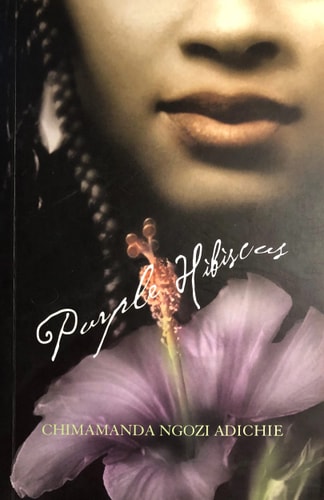
Purple Hibiscus
0
0
As an Amazon Associate and affiliate partner, Menrva Books earns from qualifying purchases. Learn more
Author Description
A haunting tale of an Africa and an adolescence undergoing tremendous changes by a talented young Nigerian writer. Fifteen-year-old Kambili's world is circumscribed by the high walls of her family compound and the frangipani trees she can see from her bedroom window. Her wealthy Catholic father, although generous and well-respected in the community, is repressive and fanatically religious at home. Her life is lived under his shadow and regulated by schedules: prayer, sleep, study, and more prayer. She lives in fear of his violence and the words in her textbooks begin to turn to blood in front of her eyes. When Nigeria begins to fall apart under a military coup, Kambili's father, involved in mysterious ways with the unfolding political crisis, sends Kambili and her brother away to their aunt's. The house is noisy and full of laughter. Here she discovers love and a life -- dangerous and heathen -- beyond the confines of her father's authority. The visit will lift the silence from her world and, in time, reveal a terrible, bruising secret at the heart of her family life. This first novel is about the promise of freedom; about the blurred lines between the old gods and the new; between childhood and adulthood; between love and hatred. An extraordinary debut, Purple Hibiscus is a compelling novel which captures both a country and an adolescence at a time of tremendous change.
Menrva's Summary
THE PULSE
Fifteen-year-old Kambili Achike struggles to navigate the suffocating religious extremism of her father's household while the political stability of Nigeria crumbles around them. Kambili lives under the rigid, violent control of her wealthy Catholic father, whose demands for perfection and piety leave no room for her own voice. When a military coup forces her and her brother to seek refuge with their aunt, Kambili encounters a vibrant, unconventional world that challenges her understanding of faith and family. The narrative, told through Kambili's observant first-person perspective, tracks her slow awakening as she weighs the safety of her father's silence against the dangerous freedom of her aunt's laughter.
INSIDE THE PAGES
- First-person perspective capturing the internal development of a teenage protagonist
- Exploration of the intersection between post-colonial politics and domestic life
- Use of religious symbolism, specifically the contrast between Catholic dogma and traditional beliefs
- Pacing that mirrors the tension between the stifling family compound and the liberating environment of the aunt's home
- Themes of silence and speech as mechanisms of power and resistance
- Detailed depiction of the socio-political instability in Nigeria during a military coup
- Focus on the psychological impact of domestic abuse and authoritarian parenting
- Sensory-rich descriptions of the Nigerian landscape and the titular purple hibiscus flowers
THE COLLECTIVE ECHO
This novel is widely recognized for its precise, evocative prose and its nuanced examination of the complexities inherent in post-colonial identity. Critics often highlight the author's ability to balance the intimate, claustrophobic nature of the family dynamic with the broader, chaotic backdrop of a nation in transition. Readers frequently note the emotional weight of Kambili's transformation, observing how the narrative avoids simplistic moral binaries in favor of a more layered portrayal of faith and rebellion. The work is frequently cited as a significant entry in contemporary African literature for its unflinching look at the intersections of power, religion, and personal autonomy.
Page Count:
288
Publication Date:
2003-10-01
Publisher:
Fourth Estate
ISBN-10:
0007176112
ISBN-13:
9780007176113
Contemporary
Literary Fiction
Family relationships
Nigeria fiction
Fathers and daughters
Divorce
Subjects
Literature & Fiction
Parenting & Relationships
Literary
Fiction
Modern fiction
Young women
Domestic Drama
Family Saga
African
Siblings fiction
Coming of Age
Community Tags
Similar Books