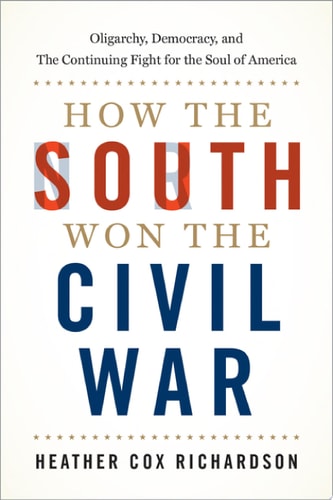
How the South Won the Civil War: Oligarchy, Democracy, and the Continuing Fight for the Soul of America
0
0
As an Amazon Associate and affiliate partner, Menrva Books earns from qualifying purchases. Learn more
Author Description
Named one of The Washington Post's 50 Notable Works of NonfictionWhile the North prevailed in the Civil War, ending slavery and giving the country a "new birth of freedom," Heather Cox Richardson argues in this provocative work that democracy's blood-soaked victory was ephemeral. The system that had sustained the defeated South moved westward and there established a foothold. It was a natural fit. Settlers from the East had for decades been pushing into the West, where the seizure of Mexican lands at the end of the Mexican-American War and treatment of Native Americans cemented racial hierarchies. The South and West equally depended on extractive industries-cotton in the former and mining, cattle, and oil in the latter-giving rise a new birth of white male oligarchy, despite the guarantees provided by the 13th, 14th, and 15th Amendments, and the economic opportunities afforded by expansion. To reveal why this happened, How the South Won the Civil War traces the story of the American paradox, the competing claims of equality and subordination woven into the nation's fabric and identity. At the nation's founding, it was the Eastern "yeoman farmer" who galvanized and symbolized the American Revolution. After the Civil War, that mantle was assumed by the Western cowboy, singlehandedly defending his land against barbarians and savages as well as from a rapacious government. New states entered the Union in the late nineteenth century and western and southern leaders found yet more common ground. As resources and people streamed into the West during the New Deal and World War II, the region's influence grew. "Movement Conservatives," led by westerners Barry Goldwater, Richard Nixon, and Ronald Reagan, claimed to embody cowboy individualism and worked with Dixiecrats to embrace the ideology of the Confederacy.Richardson's searing book seizes upon the soul of the country and its ongoing struggle to provide equal opportunity to all. Debunking the myth that the Civil War relea
Menrva's Summary
THE THESIS
The core question investigated is how the political and economic structures of the defeated South migrated westward to undermine the democratic ideals established after the Civil War. Heather Cox Richardson, a professor of history at Boston College, utilizes a synthesis of political history and economic analysis to argue that the American West became the new stronghold for an oligarchical ideology. By tracing the evolution of the 'yeoman farmer' myth into the 'cowboy' archetype, she demonstrates how racial hierarchies and extractive economic practices persisted despite the constitutional amendments intended to secure equality.
THE SCOPE MAP
What You Will Find
- Analysis of the post-Civil War migration of Southern political power into Western territories.
- Examination of the ideological shift from the yeoman farmer to the cowboy as a symbol of American individualism.
- Historical review of the alliance between Western movement conservatives and Southern Dixiecrats.
- Critique of the impact of extractive industries on democratic governance.
Scope Limits
- The text does not provide an exhaustive military history of the Civil War itself.
- It focuses primarily on the political and ideological continuity of oligarchy rather than a comprehensive biography of individual political figures.
THE AUTHORITY PERSPECTIVE
Critics and historians note the clarity of Richardson's prose in connecting disparate historical threads to explain modern political polarization. The book is frequently cited as a significant contribution to understanding the persistence of anti-democratic structures in American governance.
Page Count:
272
Publication Date:
2020-01-01
Publisher:
Oxford University Press
ISBN-10:
019090092X
ISBN-13:
9780190900922
History
United States
History of the Americas
Social History
American History
Civil War
Community Tags
Similar Books


Reader Comments
Share Your Thoughts
No comments yet. Be the first to share your thoughts!