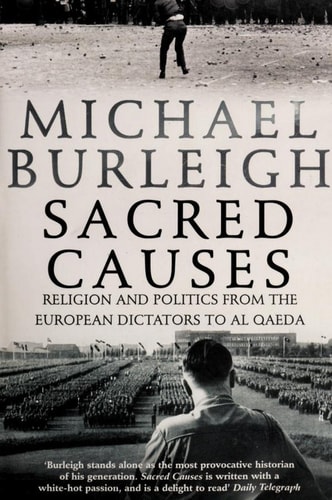
Sacred Causes: Religion and Politics from the European Dictators to Al Qaeda
0
0
As an Amazon Associate and affiliate partner, Menrva Books earns from qualifying purchases. Learn more
Author Description
Populated by many of the most iconic figures of the twentieth-century, 'Sacred Causes' provides a brilliant examination of how religion has shaped twentieth-century Europe from the Great War until the modern-day 'War on Terror'. Beginning with the chaotic post-World War I landscape in which religious belief was one way of reordering a world knocked off its axis, 'Sacred Causes' is a sweepingly assured critique of how religion has often been camouflaged by politics. Covering a vast canvas, Burleigh examines the many 'secular' religions the twentieth-century produced, analysing how successive totalitarian leaders fantasised and aped the hierarchy, rites and ritual of the churches in the desire to return to the day where ruler and deity were one.All the many bloody regimes and movements of the century are here, from Stalin's Soviet Union, Hitler's Germany, Mussolini's Italy, Franco's Spain through to the modern scourge of terrorism the current 'War on Terror'. Often blackly comic, the book shows how the church has been swayed by - and contributed to - conflicting secular currents. He traces religious beliefs and institutions from a time when the church, disenchanted with both democracy and fascism, began to search for political alternatives. During the Second World War, the churches faced agonising dilemmas, notably how to respond to the Holocaust.Combining the deeper workings of history with an urgent sense of the contemporary relevance of his material, Burleigh challenges his readers to consider why no-one foresaw the religious implications of massive Third World immigration, as well as what is driving current calls for a 'civic religion' with which to counter the terrorist threats which have so shocked the West.
Menrva's Summary
THE THESIS
This work investigates the complex and often volatile intersection of religious belief and political ideology in twentieth-century Europe, questioning how secular movements adopted religious structures to consolidate power. Michael Burleigh, a historian of political religion, utilizes a vast array of historical records and political analysis to argue that totalitarian regimes frequently mimicked the hierarchies and rituals of established churches to replace traditional faith with secular political cults. The text examines the moral dilemmas faced by religious institutions during the rise of fascism and communism, ultimately connecting these historical patterns to contemporary geopolitical challenges and the rise of modern terrorism.
THE SCOPE MAP
What You Will Find
- Analysis of the rise of secular religions in the Soviet Union, Nazi Germany, and Fascist Italy.
- Examination of the Catholic and Protestant churches' responses to the Holocaust and totalitarian expansion.
- Historical assessment of the transition from post-World War I political reordering to the modern War on Terror.
- Discussion on the sociological implications of Third World immigration and the debate surrounding civic religion in the West.
THE AUTHORITY PERSPECTIVE
This text is regarded as a dense, scholarly examination of political theology that demands a high level of historical literacy from its readers. The framing suggests an ambitious, wide-ranging synthesis that prioritizes thematic connections over a strictly chronological narrative, positioning it as a significant contribution to the study of twentieth-century political culture.
Page Count:
557
Publication Date:
2007-01-01
Publisher:
Harper Perennial
ISBN-10:
0007195753
ISBN-13:
9780007195756
History
Western
Religion
21st Century
European History
World
Europe
20th Century
Modern
State Politics
Christianity
Community Tags
Similar Books