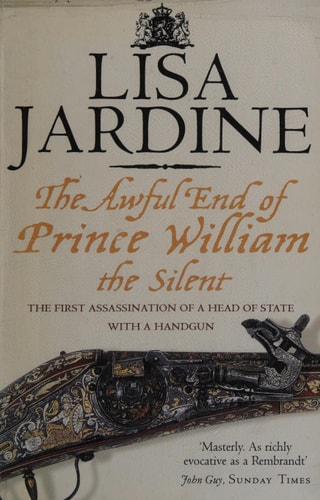
The Awful End of Prince William the Silent: The First Assassination of a Head of State with a Handgun
0
0
As an Amazon Associate and affiliate partner, Menrva Books earns from qualifying purchases. Learn more
Author Description
A brilliantly detailed and gripping account of the assassination in 1584 of Prince William of Orange, and the shockwaves it sent through an age. The illustrious 'Making History Series', edited by Lisa Jardine and Amanda Foreman, explores an eclectic mix of history's tipping points. In 'The Awful End of Prince William the Silent', series editor Lisa Jardine explores the historical ramifications of just such an instance, the first assassination of a head of state with a hand-held gun. The shooting of Prince William of Orange in the hallway of his Delft residence in July 1584 by a French Catholic - the second attempt on his life - had immediate political consequences: it was a serious setback for the Protestant cause in the Netherlands, as its forces fought for independence from the Catholic rule of the Hapsburg empire. But, as Jardine brilliantly illustrates, its implications for those in positions of power were even more far-reaching, as the assassination heralded the arrival of a lethal new threat to the security of nations - a pistol that could be concealed and used to deadly effect at point-blank range.Queen Elizabeth I, William's close Protestant ally, was devastated by his death and thrown into panic; in the aftermath of William's death, legislation was enacted in the English parliament making it an offence to bring a pistol anywhere near a royal palace. Elizabeth's terror was not misplaced - as Jardine observes, this assassination was the first in a long and bloody line including those of Abraham Lincoln in 1865 and Archduke Ferdinand in 1914 and is all too relevant today.
Menrva's Summary
THE THESIS
This work investigates the 1584 assassination of Prince William of Orange as a pivotal moment that introduced the handgun as a transformative and lethal tool for political destabilization. Lisa Jardine, a noted historian, utilizes primary source accounts and political records to analyze how the death of a key Protestant leader in the Netherlands altered the trajectory of the Hapsburg empire's conflicts. She frames the event not merely as a local tragedy, but as the inaugural instance of a modern political assassination method that forced European monarchs to fundamentally rethink personal security and statecraft.
THE SCOPE MAP
What You Will Find
- Detailed analysis of the 1584 assassination of Prince William of Orange in Delft.
- Examination of the political fallout for the Protestant cause against the Hapsburg empire.
- Historical context regarding the emergence of concealable firearms as a threat to heads of state.
- Discussion of the legislative responses in Elizabethan England to the new danger of hand-held guns.
THE AUTHORITY PERSPECTIVE
This text provides a focused, scholarly examination of a specific historical turning point, effectively linking sixteenth-century political violence to broader patterns of state security. The analysis is accessible to general readers while maintaining the rigor expected of historical inquiry into the evolution of political assassination.
Page Count:
175
Publication Date:
2006-01-01
Publisher:
Harper Perennial
ISBN-10:
0007192584
ISBN-13:
9780007192588
Biography
History
True Crime
Western
Murder
Historical
European History
Social Science
Rural
Military
Europe
16th Century
Social History
Sociology
Political History
Biography Autobiography
Royalty
Modern
Military History
Community Tags
Similar Books