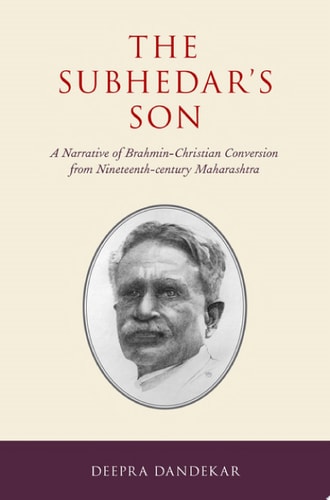
The Subhedar's Son: A Narrative of Brahmin-Christian Conversion from Nineteenth-century Maharashtra
0
0
As an Amazon Associate and affiliate partner, Menrva Books earns from qualifying purchases. Learn more
Author Description
The 19th century was a pioneering age for vernacular texts in India. Vernacular writings became popular for making the 'first' interventions of their kind, written by Indians for Indians, and establishing new genres such as the biographical novel. The Subhedar's Son, an award-winning Marathi novel, was written in 1895 and published by the Bombay Tract and Book Society, and comprised overlapping personal and political trajectories. The author, Rev. Dinkar Shankar Sawarkar, inscribed multiple viewpoints into his narrative, including that of his own father, Rev. Shankar Nana (1819-1884), a Brahmin who was one of the early converts of the Church Missionary Society in Western India and served the CMS and the Anglican Church in various capacities for many years. Apart from Shankar Nana's conversion-story, Sawarkar provides readers with a blueprint of what a Brahminical journey towards Christian conversion encompassed, while describing his personal background of having lived a Christian life as a product of both Brahminism and Christianity. Attempting to deconstruct Brahmanism through Christianity he claimed Brahmin roots as a Christian with an aim of combatting the stigma of conversion. Contextualized within the early history of Maharashtra's missions and the specificities of individual conversions, the novel allows modern researchers to appreciate the particularity of regional and vernacular Indian Christianity. This culturally-specific Christianity spurred the production of Christian vernacular print culture, associating 'being Marathi' with broader and more universal frameworks of Christianity. But this new genre also produced nativist forms of Christian devotion and piety. Deepra Dandekar introduces this annotated translation of The Subhedar's Son, with an examination of the Church Missionary Society's socio- political context; a biography of Shankar Nana gleaned from archival sources; a brief summary of Sawarkar's biography; and an analysis of the multiple political
Menrva's Summary
THE THESIS
How did the intersection of Brahminical identity and Christian conversion shape the development of vernacular literature and religious identity in nineteenth-century Maharashtra? Deepra Dandekar, a scholar specializing in the history of religion in India, provides an annotated translation of Rev. Dinkar Shankar Sawarkar’s 1895 novel. By analyzing the text alongside archival records of the Church Missionary Society, Dandekar argues that the work serves as both a personal biography of the author's father and a broader socio-political critique of the stigma surrounding conversion in colonial India.
THE SCOPE MAP
What You Will Find
- A complete annotated translation of the 1895 Marathi novel The Subhedar's Son.
- Historical analysis of the Church Missionary Society's operations in Western India.
- Biographical accounts of Rev. Shankar Nana and Rev. Dinkar Shankar Sawarkar.
- Examination of the emergence of Christian vernacular print culture in the nineteenth century.
Scope Limits
- The analysis is specifically focused on the regional context of Maharashtra and does not provide a comprehensive history of Indian Christianity as a whole.
- The text does not offer a broad theological treatise but remains grounded in the specific narrative of the Sawarkar family.
THE AUTHORITY PERSPECTIVE
Scholars of South Asian history and religious studies identify this work as a significant contribution to the understanding of regional vernacular Christianity. Experts frequently note that the text provides a rare, nuanced look at the synthesis of Brahminical heritage and Christian faith during the colonial period.
Page Count:
266
Publication Date:
2018-01-01
Publisher:
Oxford University Press
ISBN-10:
0190914068
ISBN-13:
9780190914066
History
Religion
Biography
Marathi Literature
India
Christianity
Asian History
Translation
Community Tags
Similar Books


Reader Comments
Share Your Thoughts
No comments yet. Be the first to share your thoughts!