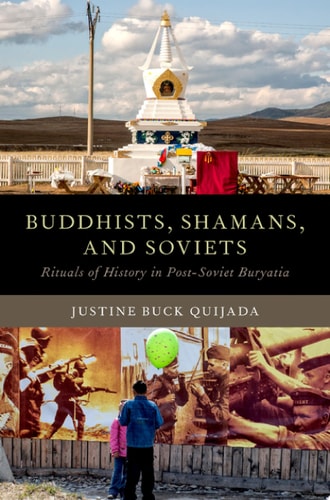
Buddhists, Shamans, and Soviets: Rituals of History in Post-Soviet Buryatia
0
0
As an Amazon Associate and affiliate partner, Menrva Books earns from qualifying purchases. Learn more
Author Description
History in the Soviet Union was a political project. From the Soviet perspective, Buryats, an indigenous Siberian ethnic group, were a "backwards" nationality that was carried along on the inexorable march towards the Communist utopian future. When the Soviet Union ended, the Soviet version of history lost its power and Buryats, like other Siberian indigenous peoples, were able to revive religious and cultural traditions that had been suppressed by the Soviet state. In the process, they also recovered knowledge about the past that the Soviet Union had silenced. Borrowing the analytic lens of the chronotope from Bakhtin, Quijada argues that rituals have chronotopes which situate people within time and space. As they revived rituals, Post-Soviet Buryats encountered new historical information and traditional ways of being in time that enabled them to re-imagine the Buryat past, and what it means to be Buryat. Through the temporal perspective of a reincarnating Buddhist monk, Dashi-Dorzho Etigelov, Buddhists come to see the Soviet period as a test on the path of dharma. Shamanic practitioners, in contrast, renegotiate their relationship to the past by speaking to their ancestors through the bodies of shamans. By comparing the versions of history that are produced in Buddhist, shamanic and civic rituals, Buddhists, Shamans and Soviets offers a new lens for analyzing ritual, a new perspective on how an indigenous people grapples with a history of state repression, and an innovative approach to the ethnographic study of how people know about the past.
Menrva's Summary
THE THESIS
This book investigates how post-Soviet Buryats utilize ritual practices to reconstruct their historical identity and navigate the legacy of state-imposed Soviet narratives. Justine Buck Quijada, an anthropologist specializing in Siberian indigenous cultures, employs the Bakhtinian concept of the chronotope to examine how religious and civic rituals function as temporal frameworks. By analyzing the divergent approaches of Buddhist practitioners, shamanic groups, and civic organizations, the author argues that these rituals serve as active sites for re-evaluating the past and defining contemporary Buryat existence.
THE SCOPE MAP
What You Will Find
- Analysis of the chronotope as a tool for understanding ritual time and space
- Comparative study of Buddhist, shamanic, and civic ritual practices in Buryatia
- Ethnographic accounts of the revival of suppressed indigenous traditions
- Examination of the reincarnating monk Dashi-Dorzho Etigelov as a temporal anchor
Scope Limits
- The study focuses specifically on the Buryat population and does not provide a comprehensive history of all Siberian indigenous groups
- The analysis is limited to the post-Soviet period and does not cover pre-Soviet historical developments in exhaustive detail
THE AUTHORITY PERSPECTIVE
Scholars in the fields of anthropology and religious studies recognize this work as a sophisticated application of Bakhtinian theory to ethnographic fieldwork. Readers frequently note the academic density of the prose, which provides a rigorous framework for understanding how communities process historical trauma through ritual performance.
Page Count:
255
Publication Date:
2019-01-01
Publisher:
Oxford University Press
ISBN-10:
0190916818
ISBN-13:
9780190916817
History
Religion
Ritual Studies
Asian History
Anthropology
Buryatia
Ethnography
Shamanism
Buddhism
European History
Soviet History
Community Tags
Similar Books