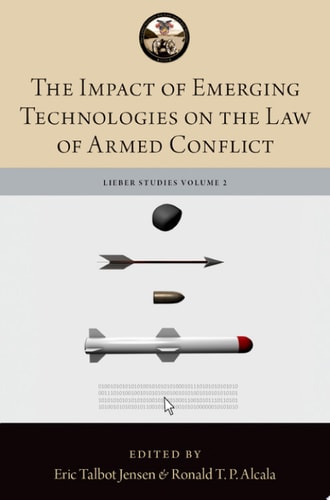
The Impact of Emerging Technologies on the Law of Armed Conflict (The Lieber Studies Series Book 2)
0
0
As an Amazon Associate and affiliate partner, Menrva Books earns from qualifying purchases. Learn more
Author Description
Emerging technologies have always played an important role in armed conflict. From the crossbow to cyber capabilities, technology that could be weaponized to create an advantage over an adversary has inevitably found its way into military arsenals for use in armed conflict. The weaponization of emerging technologies, however, raises challenging legal issues with respect to the law of armed conflict. As States continue to develop and exploit new technologies, how will the law of armed conflict address the use of these technologies on the battlefield? Is existing law sufficient to regulate new technologies, such as cyber capabilities, autonomous weapons systems, and artificial intelligence? Have emerging technologies fundamentally altered the way we should understand concepts such as law-of-war precautions and the principle of distinction? How can we ensure compliance and accountability in light of technological advancement? This volume of the Lieber Studies explores these critical questions while highlighting the legal challenges--and opportunities--presented by the use of emerging technologies on the battlefield.
Menrva's Summary
THE THESIS
This volume investigates whether existing international legal frameworks are sufficient to regulate the integration of emerging technologies into modern military operations. The authors, Eric Talbot Jensen and Ronald T. P. Alcala, leverage their expertise in military law to analyze the intersection of technological advancement and the law of armed conflict. By examining specific domains such as cyber warfare and autonomous systems, the text evaluates the adequacy of current legal principles in ensuring accountability and compliance on the battlefield.
THE SCOPE MAP
What You Will Find
- Analysis of legal challenges regarding autonomous weapons systems and artificial intelligence.
- Examination of the principle of distinction and law-of-war precautions in a digital age.
- Discussion on the evolution of military technology from historical tools to modern cyber capabilities.
Scope Limits
- The text does not provide a comprehensive technical manual for the operation of specific weapon systems.
- It does not offer definitive policy solutions for every potential future technological development.
THE AUTHORITY PERSPECTIVE
Legal scholars and military practitioners frequently cite this work as a critical resource for understanding the intersection of modern warfare and international law. Experts highlight the text for its rigorous application of established legal principles to rapidly evolving technological threats.
Page Count:
407
Publication Date:
2019-01-01
Publisher:
Oxford University Press
ISBN-10:
019091534X
ISBN-13:
9780190915346
Technology
Military Science
Armed conflict
International Law
Law
Professional Career & Trade
Community Tags
Similar Books